Friday, May 23, 2008

Khao Kradong Park : Buriram

[ Phra Suphattharabophit ]

This forest park is 6 kilometres from the city on the Buriram-Prakhon Chai road (Highway No. 219). Khao Kradong is an extinct volcano that is 265 meters high. The summit of the mountain has a pool which is believed to be the mouth of the volcano. Around the area are several plant species worth studying and Phra Suphattharabophit, an important Buddha image of the province.

tags : // /

Saturday, May 3, 2008

Wat Rajapradit : Bangkok

Wat Rajapradit is situated next to Saranrom Park closed to Khlong Ku Muang Derm Road, on the opposite side of the canal from Wat Rajabopit. King Rama IV ordered the construction of Wat Rajapradit Sathitmahasimaram in 1864 as the first temple of Dhammayutika sect. The phra vihara luang is constructed on a high base and is beautifully decorated. In the temple there are eight stone pillars, each surmounted by a carving of the Buddhist Wheel of Law (Dhammachak), one for each of the eight directions, hence the name "Mahasimaram".

During the construction of the phra vihara luang, which is the phra ubosot, it was found that the ground was rather low and the earth soft. If earth and sand were used as landfill the ground would still continue to subside. King Rama IV therefore ordered that broken garlic jars be used as landfill because the jars was especially strong.

In the phra vihara luang, there are murals depicting the royal ceremonies of the twelve months, including the Giant Swing Ceremony, Songkran, Visakha Puja as well as a picture of King Rama IV using as a telescope for his astronomical studies. On one side of the phra vihara luang there is a standing statue of King Rama IV and nearby there is a statue of the Supreme Patriarch (Sa) in a chedi covered with marble tiles.

photo and article credit to dhammathai.org

tags : // /

Saturday, April 12, 2008

Bangkok Songkran Festival


Date: 12 – 15 April 2008

Venue: at 9 royal temples and around Rattanakosin Island

Hi-Light:

  • Songkran Celebration of the 4 Regions (southern section of Sanam Luang near Wat Phra Kaeo)

  • Bathing of Buddha images from the 4 regions, local food and dessert making demonstrations, and cultural shows from various regions.
    Open Ceremony on 12th April 2008 18.00-21.00 hrs. at Wat Arun

  • Paying worship at 9 royal temples around Rattanakosin Island. On 12-15 April 2008 09.00-18.00 hrs. :
    Wat Phra Sri Rattanasasadaram (Wat Phra Kaeo)
    Wat Chetaphon (Wat Pho)
    Wat Suthat
    Wat Saket
    Wat Bowonniwet
    Wat Chanasongkram
    Wat Rakung
    Wat Arun (Wat Chaeng), and Wat Kalayanamitr

  • Fun-filled splashing in traditional Thai dress, Khao San Road with various forms of Songkran fun, on 4-15 April 2008 at 17.00-18.00 hrs.

  • Banglamphu community at Santi Chaiprakarn Park, Phra Athit Road and Wisut Kasat., on 12-13 April 2008

    Further Information : Events Planning Division, Tourism Authority of Thailand (TAT)
    Tel. 02 250 5500 ext. 3470. TAT Call Center 1672

    source: www.songkran.net

tags : // /

History of The Songkran Festival


Deriving from the Sansakrit language, the word “Songkran“ means to pass or to move into. In this context, the meaning implies to the passing and the moving of the sun, the moon and the other planets into one of the zodiacal orbit. And the Grand Songkran Festival which falls on the Aries indicates the new era of the Thai New Year. Owing to the ancient Indian belief, the Grand Songkran Festival is most appropriate to be the Thai New Year due to the timing of the best season which is known as the spring of India which comes right after the cold season of winter. Also, there are other aspects supporting this belief such as the blooming flowers, the fresh atmosphere of the nature and the livelihood of all the living creatures.

With the great influence from the Indians, the Songkran Festival portrays the typical ways of life of the Thais which involve the agricultural aspects. Free from their regular routine work, the Thai citizens will find time to perform their annual rites of showing respect to their ancestors. The highlight of the festival will include the younger Thais paying respect to their elders by sprinkling their hands with scented water. And in order to welcome the New Year, the celebration will include the delighted colourful local entertainment which, in fact, suitably unite the mutual relationship between members of the family, the society, the nature and surrounding. Therefore, this Songkran Festival has proved to be the most important and grandest festival of the year. Moreover, our neighbouring countries such as Myanmar, Cambodia and Laos have also organised this type of festival.

Since the old days during the Sukhothai period, the Songkran Festival had been practised both in the royal court palace and among the ordinary citizens. However, the size of the celebration had not been as elaborated as of today. Back in those days, civil servants and other government officials would pay homage to the king, and would drink the oath of allegiance to the king or the government, while the king would provide annual salary to all officials. Later on in Ayutthaya period, the festival had been expanded by including the bathing of the Buddha image. Also, the festivities would include the forming of sand pagodas and entertaining celebrations. In the Rattanakosin period, the rituals had been conducted in the similar pattern as those during the Ayutthaya period.

history source : www.songkran.net

tags : // /

Saturday, March 22, 2008

Wat Phra Mahathat : Nakhon Si Thamarat Province

[ photo credit : dhammathai.org ]

Wat Phra Mahathat
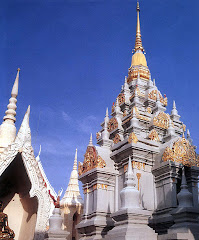
is the most important temple of Nakhon Si Thammarat. This is originally an old monastery of Nakhon Si Thamarat, situated in the heart of the city. It is believed to be constructed during Sivichaya period in compliance with the idea of Mahayana Buddhism School. An extensive complex is centred on the 77-metre pagoda houses Buddha relics brought from Sri Lanka some 1,700 years ago.

The pagoda, 55.78 meters high, has a distinctive Sri Lankan style. The top is entirely covered by pure gold. Inside the temple are many buildings of importance, especially the royal building which has beautiful architecture from the Ayutthaya period and the Sam Chom building where the Buddha image attired in royal wardrobe Phra Si Thamma Sokarat is housed. There are also the Phra Maha Phinetkrom (the equestrian image) building, the Thap Kaset building, while the Khian and Pho Lanka buildings are used to display artifacts donated to the temple by Buddhists.

Besides, there are a lot of other important archaeological places such as Vihara Luang, Vihara Khien, Vihara Khot, Vihara Pho Lanka, museum, etc.


tags : // /