Showing posts with label Phetchaburi. Show all posts

Tuesday, September 1, 2009

Wat Yai Suwannaram : Phetchaburi


[ Photo credits to www.thai-tour.com ]

This is another important temple in the town, situated 1 km. east of the city hall. The main shrine hall
has no windows. It contains 300-year-old mural paintings of mythical angels. The multi-purpose hall (Sala Kanprian), once located in Ayutthaya's Grand Palace, was entirely built of teak wood and decorated with fine carving work especially at the door panels. The hall also houses a preaching throne with intricate wood carvings and gold gilt works of Bangkok design.

Tags: ////

Friday, July 3, 2009

Phra Ram Ratchaniwet Palace : Phetchaburi


[Photo Source: kanchanapisek.or.th]

Phra Ram Ratchaniwet
(Ban Puen Palace) is a palace which King Chulalongkorn graciously built Ban Puen in 1910. Local people usually call it "Wang Ban Puen". The building shows the glamour of the Western architect and interior designer. At present, the palace is under the supervision of the Army campus of Phetchaburi province. Open daily during office hours.
This palace, originally called Ban Puen Palace, was located at Tambon Ban Mo Amphoe Muang Changwat Phetchaburi. King ChulachomWao, Rama V, desired to have it built as a rainy season palace with his own money. The plot of land was bought from a villager and the design was made by a German, Mr.Karl Deurring. Admiral HRH Prince Boriphat of Nakhonsawan and HRH Prince Damrong were assigned to monitor the construction. The palace is of European design and construc-tion began in 1909 and completed in 1916. The palace was named during the reign of King Rama Vl as Son Phetch Prasat Palace. The name was changed to be Phraram Ratchaniwet in the year 1918 when it was used as a palace to welcome and accommodate state visitors.

During the reign of King Rama VII the place was utilized, by the royal command, as Boy Scout Commanding School, Agricultural Teacher Training College, Tambon Public School, etc. In the year 1986, the Royal Thai Army requested the cooperation of the Fine Arts Department to renovate the palace spending the budget of the Fine Arts Department to the amount of 2.8 million baht and the budget of the Royal Thai Army to the amount of 8.3 million baht. The renovation was completed in the year 1987. It is expected that this palace will be used as the Phetchaburi National Museum.

source: http://www.geocities.com/RainForest

Tags : / / / /

Friday, June 1, 2007

Wat Mahathat Worawihan : Phetchaburi


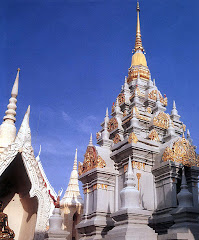
about 500 meters from the city hall, an ancient temple on the west bank of Phetchaburi river. There is a five-peak pagoda which is assumed to have been built in Khmer period. (approximvately 800 years ago). Within the biggest peak of the pagoda lies relics of Buddha which were presented by the King in 1954.

The most impressionable site is the beautiful and elaborately decorated stucco molded by Petchaburi artisans. One can see the intricate and detailed work done by the former artisans and the new generations. As well included inside the edifice are various images of
Buddha, 3 of which are highly respected and cherished by the people of Phetchaburi.

Related Tags: //////

Tuesday, April 24, 2007

Phra Nakhon Khiri : Phetchaburi


Phra Nakhon Khiri Palace or the Holy City Hill was the first palace built on the mountain range by King Rama IV in 1859 for the King himself and for the royal guests.

It is studded with Wats and various components of the palace such as Wat Mahasamanaram locates on the hill-step, Wat Phra Kaeo which is the temple of the palace locates on the hill-top. The middle peak enshrines Phra that Chom Phet and the eastern peak is a vicinity of the compound. The architectural style of the palace is mixed between European, Chinese and Thai.

photo: moohin

Technorati tags : / / / /

Wednesday, April 11, 2007

Wat Kamphaeng Laeng : Phetchaburi

The biggest and oldest historical site, Wat Kamphaeng Laeng provides evidence of Phetchaburi as a great settlement from 12th – 13th centuries.

The prasat of three late rite tall stupas Prang is the architecture influenced by the Khamer of Bayon period It is surrounded by kamphaeng laeng or a laterite wall with some intact arched doors called Khopura. On the stone walls appeared the Dvaravati stucco mouldings such as the pattern of Naga or serpant gripped in the mouth of dragon and the columns. This is the masterpiece artists who create their own artistic work.


source: www.thai-tour.com

Technorati tags : , , , ,

Tham Khao Luang : Phetchaburi


This cave is located approximately five kilometers from khao Wang. From the foot hill, there are concrete stair cases leading to the cave entrance. Khao Luang is a small-sized hill having a height of 92 meters at the peak. However, Khao Luang Cave is regarded as the Largest and most important cave of Changwat Phetchaburi because the important ornamented Buddha image built by King Rama V and dedicated to King Rama III and IV is enshrined here. This cave had been a royal picnic site since the King Rama IV period. He was very fond of this place so that he commanded the renovation of several old Buddha images in the cave.

On the right hand side of the entrance at Khao Luang foot hill, there is a big beautiful monastery called by Phetchaburi folks Wat Tham Klaep which is now Wat Bun Thawi. There are some interesting items to be seen in this monastery such as a hude multipurpose pavilion, and beautiful wood carved door panels of the main shrine hall which was designed and constructed by the Lord Abbot who was a famous artisan. The old legend told by Phetchaburi folks for centuries is that the entrance of the cave at this monastery is the entrance of a twilight zone town where inhabitants are only young maidens.


Technorati tags : , ,,