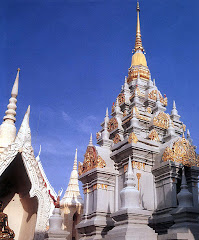
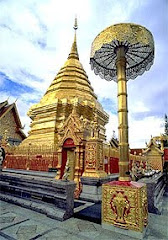
Wat Tha Sung (another name is Wat Chantharam) is at Mu 2, Tambon Nam Sum. It is an old temple from the Ayutthaya period. It was formerly called “Wat Chan” which is the name of an abbot. Wat Chantharam later was abandoned until 1789 when the monk Luang Pho Yai came here. Villagers asked him to become the abbot of the temple and he renovated it.
The first location of the temple was on the bank of Sakae Krang River. The artifact of the place is a pulpit built by Luang Pho Yai that is opposite the temple. More buildings were later added by the monk Phra Ratchaphrom Yan Nen (Luang Pho Ruesi Ling Dam). The new convocation hall is beautiful with an ornately decorated interior.
The inner windows and doors have pictures of angels. His Majesty the King presided over a ceremony to officially open the building. Surronding the building is a traditional columned wall. Images of Luang Pho Pan and Luang Pho Yai 3 times the actual size is at the corner of the front wall. Furthermore, the new site has a wide area as well as many pavilions with accommodation for meditation. The main hall is open during 09.00-11.45 hrs. and 14.00-16.00 hrs. daily.
Thursday, May 26, 2011
Wat Tha Sung : Uttraradit


Sunday, May 8, 2011
Wat Ming Mueang : Nan

Wat Ming Mueang is on Suriyaphong Road. It was constructed in 1857. Its distinguishing point is the stucco reliefs on the outer wall of the ubosot, presenting the skill of the Chiang Saen craftsmen. The patterns are very exquisite. Within the ubosot are mural paintings depicting the lifestyles of the Nan people by present-day local craftsmen. Moreover, within the compound of the temple stands the city pillar in a cruciform-plan pavilion at its front. The city pillar is 3 metres high. Its base is decorated with engraved and gilded wooden design. The top of the pillar was engraved into 4 faces of the Brahma God, representing Phrom Wihan (Brahmavihara) 4 – the four sublime states of mind; namely, Metta - kindness, Karuna - compassion, Mudita – sympathy, and Upekkha - equanimity.
Wat Woranat Banphot : Nakhon Sawan

Wat Woranat Banphot (Khao Kop) is an old temple of the province on the peak of Khao Kop 185.5 meters above sea level. There are 2 ways up; a stairway of 439 steps and an asphalt road 3 meters wide. The peak has a replica of Lord Buddhas Footprint and a pagoda encasing the relic of Lord Buddha built when Sukhothai was the countrys capital. The temple was praised by the Department of Religious Affairs as the best development temple of 1966. A nearby hill is the site of some television relay stations.
Tuesday, February 9, 2010
Wat Khao Di Salak : Suphanburi


Archaeologists presumed that the footprint is an art object of the Dvaravati style, dating back to 9th -11th century. Furthermore, Buddha images and artefacts were discovered from a rock cavity. From the peak, you can enjoy a panoramic view of the town.
Photo credits to www.suphanburi.go.th
Wat Pa Lelai : Suphanburi


This is a very old temple located on the west bank of the river on Malaimaen Road in the town. It is believed to have been built some 800 years ago when Suphan Buri was a prosperous community. A huge sitting Buddha image named "Luang Pho To", 23 metres in height, is enshrined in the main chapel. The image was originally situated in the open area and was later covered by the chapel. Worship fairs celebrating the image are held twice a year in April and November.
In addition, an old Thai style house called Khum Khun Chang has been built in the temple compound. The design of the construction has followed the description in Khun Chang-Khun Phan, a classic Thai poem which is a work of Sunthon Phu, the greatest poet of Thailand during the early Bangkok period.
Photo credits to www.suphanburi.go.th
Thursday, September 17, 2009
Wat Phra That Doi Tung : Chiang Rai

Wat Phra That Doi Tung is located on top of Doi Tung Mountain, the highest mountain in Chiang Rai Province with an elevation of approximately 2,000 meters, about 50 kilometers south of Mae Sai town which is near the Myanmar border. The temple can be reached via a 40-kilometer mountain road which meanders along the mountainside. The journey is worthwhile as the panoramic views into Laos and Myanmar at the peak are spectacular.
Wat Phra That Doi Tung was constructed in the 10th century and was renovated by Chiang Rai's most famous ruler King Mengrai during the 13th century and by the famous Chiang Mai monk, Khru Ba Siwichai, at the turn of the 20th century.
The temple complex is comprised of twin Lanna style chedis, one of which is said to contain the left collarbone of the Lord Buddha. Throughout the year, the holy relic draws devout Buddhists from all over Thailand, Laos and Myanmar.
Tags : Wat Phra That Doi Tung/Chiang Rai/Thailand/Thai temple/buddhist temple
Friday, September 11, 2009
Wat Chaiyo Worawihan or Wat Ket Chaiyo : Ang Thong

Wat Ket Chaiyo is situated on the west bank of the Chao Phraya River, approximately 18 kilometers away from Amphoe Mueang Ang Thong, on Ang Thong Sing Buri route. This is the second-class royal monastery. Formerly it was a small ordinary temple constructed in the Ayutthaya period with the unknown building date. Later in the reign of King Rama IV, this temple was noted when Somdet Phra Phutthachan (To Phromrangsi) a revered monk of Wat Rakhangkhositaram in Thonburi constructed a large seated Buddha image in the posture of meditation made of white plaster.
In the reign of King Rama V, His Majesty the King went to worship the image and had Wat Chaiyo renovated in 1887 but the vibration from ramming piles of the wihan caused the large Buddha image to collapse. The king then commanded to build a new large Buddha image following the pattern of the large Buddha image at Wat Kalayanamit. The new one has the lap width of 16.10 meters and the height (from radiance to feet) of 22.65 meters and was graciously named Phra Mahaphutthaphim. There was the biggest celebration for the image ever held in Ang Thong at that time. The molded statue of Somdet Phra Phutthachan (To Phromrangsi) constructed in 1894, having the lap width of 5 meters and the height of 7 meters, has been enshrined in the wihan facing the Chao Phraya River.

The large Buddha image housed in this wihan is larger, more elegant, and more remarkable wihan than any other, therefore, Buddhists from various parts of the country have continuously paid homage to this image. In front of the wihan, the ubosot facing the was constructed using the magnificent Thai architectural design. Inside the ubosot, there are mural paintings depicting scenes of the Lord Buddhas chronicles painted by the artisan in the reign of King Rama V, and the molded statue of Somdet Phra Phutthachan (To Phromrangsi) from Thonburi. At present, Chao Phraya RiverWat Chaiyo Worawihan has been renovated to exhibit its distinctive beauty.
Photo credits to kedchaiyo.com, dhammathai.org
Wat Phra Thaen Sila At : Uttaradit

A little further from Wat Phra Yun, some 14 kilometres from town is Wat Phra Thaen Sila At. The major feature is the base of a sermon platform built with laterite. The square slab with pattern is believed to have been made during the Sukhothai Period. Annual celebrations are held at the three temples in February.
Tags : Wat Phra Thaen Sila At /Uttaradit/Thailand/Thai temple/buddhist temple
Wednesday, September 9, 2009
Wat Khao Wong : Uthai Thani

Wat Khao Wong is a temple in a valley. It has a beautiful two-storey Thai-style convocation hall. The area has been exquisitely landscaped. The monastery is the 13th of 19 branches of Wat Sangkhathan in Nonthaburi that are in places such as Chiang Mai, Um Phang, the United Kingdom, and India. The monastery was built in 1987 and has a total area of 320,000 square metres. The surrounding area is mountain and forest.
The most striking feature of Khao Wong Monastery is the 4-storey Thai-style multi-purpose pavilion. Built almost entirely of wood, the pavilion has a pond in front with many fish. Around the pond is a garden of colourful flowers. The wood used in the pavilion’s construction was donated by locals and has been transformed into a work of architecture that retains natural qualities. The monastery has a monthly meditation class for those who are interested.
Getting There: Use the same route as Phu Wai Cave. It is about 3 kilometres before reaching the cave (there is a cooperative store selling souvenirs and free accommodation for up to 200 persons).
Tags : Wat Khao Wong /Uthai Thani/Thailand/Thai temple
Sunday, August 30, 2009
Wat Phaya Wat : Nan

This temple is located just before reaching the town on Highway No. 101. An ancient religious site, it has rectangular Chedi bases on which Buddha states are placed around the Chedi structure. Combined artistic influences of Lanna, Lan Chang and native Nan can be detected.
Wat Pa Fang : Lampang

Built during the reign of King Rama IV by Burmese, Wat Pa Fang is located on Sanam Bin Road. It has a large, glittering gold Chedi containing a Holy Relic brought over from Myanmar around 1906. The extensive Sala Kan Parian (preaching hall) is made entirely of wood with Burmese-style overlapping roofs. A small Ubosot has a Burmese-style woodwork over its roof with beautiful plaster designs over its doors. Usually there are a considerable number of Burmese monks in residence
Tags : Wat Pa Fang /Lampang /thai temple /Thailand Temple /Wat
Wednesday, August 19, 2009
Phrathat Kham Kaen : Khon Kaen

source: www.kku.ac.th
Tags: stupa/Khon Kaen/Phrathat Kham Kaen/Phrathat Phanom/thai temple/Thailand
Wat Phra Kaeo : Chainat

Tags: Wat Phra Kaeo/Chainat/Thai temple/Dvaravati/Thailand temple/ancient temple
Tuesday, August 18, 2009
Wat Phra That Doi Chom Thong : Chiang Rai

It is located on Doi Chom Thong on the bank of the Kok River within town area, contains what is believed to be the oldest Holy Relic even before King Mengrai built Chiang Rai. The Chedi containing the Holy Relic was probably renovated at the same time the town was being built. A major religious site in Chiang Rai was from here that King Mengrai spotted the strategic location on which to establish the town.
Tags: Chiangrai/Wat Phra That Doi Chom Thong/thai temple/Thailand temple/temple
Thursday, March 20, 2008
Wat Chalong : Phuket Province

Wat Chalong is Phuket’s most important Buddhist temple and is the biggest and most ornate of Phuket’s 29 Buddhist monasteries.This is where stands the cast statue of Luang Por Cham,who helped the people of Phuket put down the Angyee, or Chinese Coolie, Rebellion in 1876 during the reign of Rama V.
There are also statues of Luang Por Chaung, and Luang Por Gluam. Other monks, who
were abbots of the temple during later times, and who are the objects of respect and recipients of the
offerings by Phuket people generally.
Wat Chalong, was built in 1837.The architecture is typical of Wats found throughout Thailand.A recent addition to the temple is a 61.4-meter high chedi containing the Phra Borom Sareerikatat relic, a piece of the Lord Buddha's bones brought over from Sri Lanka.The chedi is a mixture of southern, central and northeastern architectural styles and is the first in this region to house the holy Buddha's relic.
How to get there. :
Wat Chalong is about 8 kms. outside town. Take Vichit Songkram Rd., to the Bypass Rd., and turn left, and drive for about 10 mins. Wat Chalong will be on your left
Related tags : Wat Chalong /Phuket/Thailand Temple /Thai temple
Wednesday, March 12, 2008
Beautiful Buddha image of Wat Si Chum : Sukhothai Province
 The Buddha image of Wat Si Chum ( Phra Achana )
Wat Si Chum
This lies about 1,500 meters north of Wat Mahathat and was originally surrounded by a moat. A square mondop is the main sanctuary and contains a monumental stucco-over-brick Buddha image in the attitude Subduing Mara, called "Phra Achana". This Buddha measures 11.30 meters from knee to knee.
The mondop is 32 meters square and 15 meters high, and the walls are 3 meters thick. There is a passageway in the left inner wall itself which leads to the above crossbeam. On the ceiling of the passageway are more than fifty engraved slate slabs illustrating Jataka scenes.
At Wat Si Chum there is a mondop that houses a large stucco image of the Buddha in the Marnvichai position, as described in the first stone inscription. A tunnel has been made leading to the temple's south wall, where there is a stariway to the roof. Over the ceiling are 20 stone pillars, with inscriptions in the Thai alphabet of the Sukhothai Period
Related tags : Sukhothai /Wat Si Chum/Thailand Temple /Buddha image/Wat Mahathat
Tuesday, March 11, 2008
Wat Khao Phanom Phloeng and Wat Sa Si : Sukhothai Province

Wat Khao Phanom Phleng is a hilltop temple within the old town of Si Satchanalai. A laterite chedi in the center, s large viharn or image hall in front, and a small sanctuary behind all lie in ruins. Some laterite pillars and a damaged Buddha's image constructed of latelite slabs and coated with mortar are still to be seen.
Wat Sa Si
Situated near Wat Chanasongkhram is Wat Sa Si. Around a Singhalese-style chedi is the main sanctuary on an island in the middle of Traphang Trakuan pond. A large viharn contains a stucco Buddha image. To the south stand nine chedis of different sizes.
Related tags : Sukhothai /Wat Khao Phanom Phloeng/Thailand Temple /Wat Chanasongkhram
Friday, December 28, 2007
Wat Ratchanatdaram : Bangkok

Located on Mahachai Road. This royal temple was built in the reign of King Rama III in 1846. Loha Prasat (Metal Palace), one of its tourist attractions, standing on its 36 meters high with 37 surrounding spires is the only one of its kind left in the world. Situated in the nearby area are a royal pavilion for a guest welcome and the memorial statue of King Rama III.
Important Buildings in the Temple
The Ordination Hall
Parallel to the canal, this edifice built in the style of King Rama III's period. There are square pillars all around it. The gable is decorated with stucco.
The main Buddha image inside is cast of copper, mined at Chanteuk in Nakhon Ratchasima province. It was placed there in A.D. 1864 by order of King Rama III. King Rama IV gave the name "Phra Setthamuni" to the image.
source:http://www.geocities.com/RainForest/7153/watratda.htm
Related tags : Wat Ratchanatdaram/royal temple/Bangkok/Thailand Temple/Wat Thai
Thursday, December 13, 2007
Wat Benjamabophit ( Marble Temple ) : Bangkok

WAt Benjamabopit Dusitwanaram (Wat Ben) , the Marble Temples, in located near Government House and the Equestrian Statue of King Rama IV. It is an old temple during from the Ayutthaya Period and was originally names Wat Laem or Wat Saithong. During the reign of King Rama IV, the temple was restored by five princes and renamed Wat Bejamabopit (five princes). In 1899 , King Rama V had the temple completely rebuilt and bestowed upon it the name Wat Benjamabopit Dusitwanaram , meaning the Temple of the Fifth King. He placed Prince Narissaranuwattiwong, the nation's chief architect, in change of the design and construction.
The name Marble Temple derives from the phra ubosot , which is square and completely covered with white marble . In it is enshrined a reproduction of the Phra Buddhachinarat image, which King Rama V had copied from the original in Phitsanulok Province.
 [ Phra Buddhachinarat image ]
In the cloister extending from the north, around the west, to the south of the phra ubosot , there are 52 Buddha images of various styles and periods.
In the monastic residence area is a royal ordination hall, which was reconstructed there after having been moved from the Grand Palace. It was in this King Rama V lived when he entered the monkhood. The murals in this building are of historical interest, showing courtly customs and traditions during the reigns of King Rama IV and Rama V.
source: dhammathaiRelated tags : Wat Benjamabophit/marble temple/Bangkok/Thailand Temple/Wat Thai
Tuesday, October 30, 2007
Wat Suwandararam : Ayutthaya
 Wat Suwandararam was built in very late Ayutthaya Period by the Father of King Rama I of Ratanakosin. The temple was then named "Wat Thong". The temple has been well looking after by the Kings of Rattanakosin Period.
In the ordination hall at Wat Suwandararam there are mural paintings which were painted to order of many Kings. King Rama IV of Rattanakosin had ordered the painters to paint scenes from the Chronical. In this picture the scene of King Naresuvara declaring independent from the Burmese. [ This masterful mural in ordination hall of Wat Suwandararam, Ayutthaya, shows the brave King Naresuan on elephant back defeating the Burmese Crown Prince (Phra Mahauparacha) in 1592 ]
Related tags : Wat Suwandararam /Ayutthaya /Ayutthaya Period /Rattanakosin Period /Thailand Temple
/mural paintings