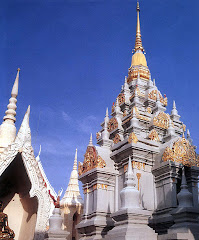
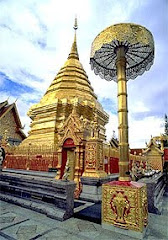
[ photo: dhammathai.org ]
The Royal Chapel is surrounded on four sides by cloister-like gallerie. It was constructed in the late 18th century during the reign of King Rama I, and has a total of seven portals. Of these, the two most often used are each equiped with a disrobing pavilion and its attached palanquin-mounting platform: one is located to the west of the gallery opening onto the Palace grounds; the other is on the east and leads to the Swatdi-Sopha Gate and out into the city.
These pavilions served for the king to change from his monarchal attire into suitable garments for worship prior to entering the precincts of the Chapel, and to change back on his way out. Another note-worthy portal is the Sirattana Satsada Gate to the south of the Gallery. This portal opens onto the inner court of the Grand Palace. It was through this portal that the ladies of the Palace used to make their way to the Royal Chapel for worship, merit-making and other religious ceremonies.

The gallery is noted for its murals depicting the entire Ramakian (the Thai version of the Ramayana epic). The verses telling the story of the painting are inscribed on marble slabs imbedded on the four sides of each pillar supporting the gallery roof. There are 4,984 verses altogether. Though originally painted when the Gallery was built, the murals as seen today reflect little of the art of the First Reign because the chronic dampness that affected the walls of the Gallery caused rapid deterioration and peeling of the murals, necessitating frequent restorations throughout the two centuries of their existence.
Conservations was carried out during the Third, Fourth and Fifth Reigns but it is not certain whether the murals were nearly retouched or entirely repainted. For the 150th Anniversary of Rattanakosin in A.D. 1932 the paintings were white-washed over and painted anew. The most recent restoration was done in the present reign; starting in 1965, it took seven years to complete, and modern technology was employed in an attempt to prevent future humidity problems.
source: http://www.geocities.com/RainForest/7153/pakao22.htm
Related tags : Wat phra kaew /Bangkok /Ramakien /Mural painting /Wat/Thailand Temple/thai temple