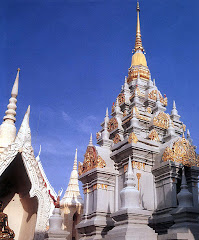
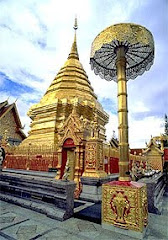
Wednesday, October 3, 2007

Wat Uposatharam (Wat Bost) : Uthai Thani Province

Mural Paintings at Wat Ubosatharam


[ Photo : www.uthaithani.go.th ]


This monastery is situated on Ko Thepho opposite to Uthai Thani Province Market, commonly called by the residents as "Wat Bot". The early Rattanakosin period mural paintings on the walls of the main shrine hall are regarded as very beautiful. Paintings of divine being are on the upper part while scenes from the life of the Lord Buddha decorate the lower part of the wall.


Related Tags: ////

Phra Rabiang (The cloister or Galleries) : Wat Phra Kaew


[ photo: dhammathai.org ]

The Royal Chapel is surrounded on four sides by cloister-like gallerie. It was constructed in the late 18th century during the reign of King Rama I, and has a total of seven portals. Of these, the two most often used are each equiped with a disrobing pavilion and its attached palanquin-mounting platform: one is located to the west of the gallery opening onto the Palace grounds; the other is on the east and leads to the Swatdi-Sopha Gate and out into the city.

These pavilions served for the king to change from his monarchal attire into suitable garments for worship prior to entering the precincts of the Chapel, and to change back on his way out. Another note-worthy portal is the Sirattana Satsada Gate to the south of the Gallery. This portal opens onto the inner court of the Grand Palace. It was through this portal that the ladies of the Palace used to make their way to the Royal Chapel for worship, merit-making and other religious ceremonies.


The gallery is noted for its murals depicting the entire Ramakian (the Thai version of the Ramayana epic). The verses telling the story of the painting are inscribed on marble slabs imbedded on the four sides of each pillar supporting the gallery roof. There are 4,984 verses altogether. Though originally painted when the Gallery was built, the murals as seen today reflect little of the art of the First Reign because the chronic dampness that affected the walls of the Gallery caused rapid deterioration and peeling of the murals, necessitating frequent restorations throughout the two centuries of their existence.

Conservations was carried out during the Third, Fourth and Fifth Reigns but it is not certain whether the murals were nearly retouched or entirely repainted. For the 150th Anniversary of Rattanakosin in A.D. 1932 the paintings were white-washed over and painted anew. The most recent restoration was done in the present reign; starting in 1965, it took seven years to complete, and modern technology was employed in an attempt to prevent future humidity problems.

source: http://www.geocities.com/RainForest/7153/pakao22.htm

Related tags : / / / ///

Monday, September 10, 2007

Prasat Phra Thep Bidon (The Royal Pantheon) :Wat Phra Kaew


The construction of the Royal Pantheon commenced in the year 1855, the first year of King Rama IV's regin. He intended to use it for the enshrinement of the Emerald Buddha. However, it was not completed until after his death, and his successor, King Rama V, did not move the palladium to the new building which he considered too small to accomodate the congregation at royal ceremonies. A Small gilt stupa belonging to King Rama IV was placed there instead.

The Royal Pantheon was built on a cruciform plan with four porticoes and a corncob shaped tower-like superstructure known as "prang", in 1903 the gilt stupa together with part of the edifice was destroyed by fire. After the repair of the building King Rama IV, the then reigning king, mde use of it as the Royal Pantheon of the Chakri Dynasty, bestowing on it the name Prasat Phra Thep Bidon (meaning the Shrine of the Celestial Ancestors). Life-size statues of the five preceeding kings from King Rama I to King Rama V were initially installed: those of King Rama VI, King Rama VII and King Rama VIII were installed later, after their deaths, and the Royal Pantheon was opened to the public to pay homage to their past sovereigns on April 6, the anniversary of the Founding of the Chakri Dynasty. The Royal Pantheon is noted for its eye-catching gilt lacquer angel-motif designs on the outer panels of the doors and windows, and for the decorative motif based on the emblems of each of the first five sovereigns of the Dynasty on the side panels of the outer recesses of the doors and windows. On the lintels are stucco gold designs composed of royal decorations.

Inside the Royal Pantheon, stands the mother-of-pearl inlaid cabinet for the canonical texts. The cabinet with its tiered roof is one of the most exquisite examples of the early Rattanakosin work of art whose creator, one of King Rama I's highest ranking courtiers, evidently strove to rival the best of Ayutthaya inlay workmanship. The dimensions of the cabinet in relation to those of the doorways of the building shows conformation to the convention of making the scripture cabinets larger than the exits so that thaey could not be removed from the place where they rightly belonged.

source:http://www.geocities.com/RainForest/7153/pakao9.html

photo credit :oceansmile

Related tags : ////

Wat Phra Lao Thep Nimit : Amnat Charoen Province


Wat Phra Lao Thep Nimit is on Highway 2049 about 2 kilometers from Amphoe Phana centre. It is an old temple. Phra Lao Thep Nimit, an ancient Buddha image, is houses in the beautiful ordination hall is about 200 years old. The Ubosot (convocation hall) is of the Lanna architectural style .The principal sacred Buddha image, in the attitude of Subduing Mara is lacquered and gilded.

source:
Tourism Authority of Thailand

photo:thai-tour


Related Tags: ////

Friday, August 24, 2007

Wat Supattanaram : Ubon Ratchathani


This is a royal temple of the Dhammayut Sect in the northeast. The temple, built in 1853 on the bank of the Mun River surrounded by beautiful and tranquil scenery. There is a Thai-Chinese-European style ordination hall, which houses the principal serene Buddha image of the temple.

photo: thai-tour
Related Tags: ////