Sunday, August 30, 2009

Wat Nong Daeng : Nan


[ Photo credits to www.nan.go.th]

Wat Nong Daeng
in Puea sub-district was constructed in 1787 by the Thai Lue and Thai Phuan people. The main Buddha image was cast by Khruba Sitthikan. The first renovation of the assembly hall was done in 1949 and again later in 1995. It was completed in 1996. Within the compound of the temple is a large shady terrace. The Chofa – gable finial decoration of a Buddhist temple’s roof – is engraved into the sculpture of Nok Hatsadiling (Hastilinga) – a mythical bird in the literature whose tip of the beak is an elephant’s trunk. The Thai Lue people believe that it is a high-ranked animal from heaven. At the same time, the eaves boards are embellished with wooden fretwork, the unique ones of the Thai Lue people. The Buddha image is enshrined on the Chukkachi base – a masonry base of intertwined Nagas, called Naga Throne. It has been believed that the Naga is a symbol of gracefulness, goodness, and a protector of Buddhism. Wat Nong Daeng was granted the Award of Outstanding Performance in the category of Cultural Attraction in Northern Thailand in the 5th Thailand Tourism Awards 2004.

Tags: ////

Wat Phaya Wat : Nan


[ photo credits to www.nan.go.th]

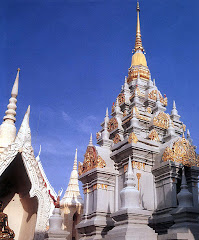
This temple is located just before reaching the town on Highway No. 101. An ancient religious site, it has rectangular Chedi bases on which Buddha states are placed around the Chedi structure. Combined artistic influences of Lanna, Lan Chang and native Nan can be detected.

Wat Pa Fang : Lampang


[ Photo credits to www.thai-tour.com ]

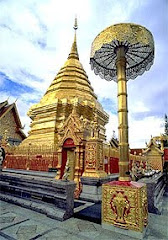
Built during the reign of King Rama IV by Burmese, Wat Pa Fang is located on Sanam Bin Road. It has a large, glittering gold Chedi containing a Holy Relic brought over from Myanmar around 1906. The extensive Sala Kan Parian (preaching hall) is made entirely of wood with Burmese-style overlapping roofs. A small Ubosot has a Burmese-style woodwork over its roof with beautiful plaster designs over its doors. Usually there are a considerable number of Burmese monks in residence


Tags :
/ / / /

Prasat Pueai Noi : Khon Kaen


Prasat Pueai Noi
is the largest Khmer sanctuary in the upper Northeast. The compound comprises 3 brick buildings built on the same laterite base. All face to the east. Each pagoda has a sandstone lintel with designs. Each pagoda has a smaller chapel and a lintel with clear, lovely designs. A laterite wall surrounds the compound and there is a pool just beyond it. From Khon Kaen, take Highway No. 2 for 44 kilometres to Ban Phai, then take Highway No. 23 for 11 kilometres to Borabu district, then take a right-hand road for 24 kilometres to Ku Pueai Noi.


Tags: ///

Wednesday, August 19, 2009

Phrathat Kham Kaen : Khon Kaen


This is a 19-metre stupa at Wat Chetiyaphum, Amphoe Nam Phong, about 26 km. northeast of Khon Kaen. According to legend, King Moriya, a ruler of Cambodia, ordered revered monks to carry the Lord Buddha’s ashes to be enshrined in Phrathat Phanom of Nakhon Phanom Province. On their way stood a dead tamarind tree, the sun was setting, they settled for the night there. In the morning, the monks continued their journey. Unfortunately, when they arrived, Phrathat Phanom had already been built, so they decided to head home. Once again passing the tamarind tree, but this time tree stood vivaciously alive, sprouting its branches and leaves as if to convey that the ashes should be situated here. Therefore, the monks advised the local villagers to build a stupa on the spot, which was obviously sacred.

source: www.kku.ac.th

Tags: /////