Showing posts with label LAMPANG. Show all posts

Thursday, September 17, 2009

Wat Phra That Chom Ping and Wat Si Rong Mueang : Lampang


Wat Phra That Chom Ping :
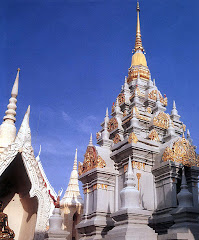
Using the same route as Wat Phra That Lampang Luang but taking a left turn at the district office and continue on for 14 kilometres is Wat Phra That Chom Ping. Another age-old temple of Lampang, its unique feature is the reflections in natural colors of Chedi which appear on the floor within the dark interior of the Ubosot.


Wat Si Rong Mueang
:
To the west of town is Wat Si Rong Mueang , a Burmese temple built in 1905 during the time when Lampang was the commercial and forestry centre. Major architectural works include the Vihan made of wood with several overlapping gables in the Burmese style. It is a temple with elaborate carving decorations and plaster designs adorned with colored glass fashioned with delicate craftsmanship.

Photo source: www.lampangcity.go.th, www.thai-tour.com

Tags : // ///

Sunday, August 30, 2009

Wat Pa Fang : Lampang


[ Photo credits to www.thai-tour.com ]

Built during the reign of King Rama IV by Burmese, Wat Pa Fang is located on Sanam Bin Road. It has a large, glittering gold Chedi containing a Holy Relic brought over from Myanmar around 1906. The extensive Sala Kan Parian (preaching hall) is made entirely of wood with Burmese-style overlapping roofs. A small Ubosot has a Burmese-style woodwork over its roof with beautiful plaster designs over its doors. Usually there are a considerable number of Burmese monks in residence


Tags :
/ / / /

Tuesday, April 17, 2007

Wat Phra Kaew Don Tao :most important temple in the city of Lampang

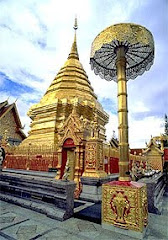
On the right bank of the Wang River is an old building which consists of an impressive chedi on a rectangular base with a round spire, topped with gilded bronze tiles. Nearby is a Burmese-style chapel featuring a multi - tiered roof. The chapel probably dates from the late eighteenth century. Beautiful colors and elaborate harmony make Wat Phra Kaew Don Tao a prime example of Thai architecture.

Perhaps the most important temple in the city of
Lampang is Wat Phra Kaeo Don Tao, the temple of the Emerald Buddha. The temple was home for 32 years in the fifteenth century to Thailand's national symbol, the Emerald Buddha, now housed in its own temple inside Bangkok's Grand Palace.

The temple, and in fact the city of
Lampang itself, is said to have been founded by the son of Lamphun's founder, Queen Chama Devi, in the seventh century. The 50 meter (165 foot) chedi is the only structure that survives of the original temple. In front of the chedi is a Burmese styled open prayer hall built in 1909 by Burmese immigrants at the request of a Thai prince.

In the fringe of trees behind the chedi is a statue of an elephant with a small sort of pavilion on its back. The statue commemorates an event in the legend of the Emerald Buddha image. The image was discovered early in the fifteenth century when lightening cracked open the chedi in Chiang Rai's
Wat Phra Kaeo. After its discovery, the King of Chiang Mai sent some troops with an elephant to bring the image to Chiang Mai. But, as the story goes, the elephant refused to take the road to Chiang Mai and ended up in Lampang instead.

The
Emerald Buddha was allowed to reside at the temple for 32 years before it was finally 'convinced' to be taken to Chiang Mai, where it resided in Wat Chedi Luang.

Elsewhere in the compound is a rather decrepit museum of Lanna culture. Some china and woodcarving is on display.

source: www.thaiabc.com

Technorati tags: / / / / /

Wat Chedi Sao :LAMPANG

Wat Jedde Sao is the temple with 20 white pagodas where the gold buddha : sansae was erected. This temple is only 6 kms. from town on Lamplan-Chaehom road.

A short distance from Lampang, set amid farms and rice fields, is Wat Chedi Sao. The name literally means "the Temple of Twenty Chedis" and one look at the 20 stupas in the temple courtyard makes it easy to understand the orgin of the name.

The origin of the temple itself is less clear. A legend recounted at the temple says that two monks from India came to the area about 2,000 years ago to spread the teachings of Buddha. A local prince was much impressed and asked each of the monks for ten hairs. He then built the temple, placing one hair in each chedi.

Some time later, two brothers dug two wells to honor the two monks. Both wells filled with clear water, and can still be seen in the grounds of the temple today.

Statues of mythical gods and creatures are dotted around the chedis, including beasts from both Chinese and Hindu legends. There are also Buddha images in many different styles, including the rare 'emaciated' Buddha shown at right.

Behind the chedis is a small two storey museum. The upper floor displays artefacts recovered in and around the temple. The lower floor contains many things donated to the temple for monk's use over the years, and includes old fashioned bicycles, 16mm movies, old phonograph records and, gathering dust in the back, an old Macintosh Plus computer.

Behind the temple's main hall is a smaller richly decorated wiharn that contains a much revered Buddha image. The fifteenth century cast image was discovered by a farmer in his rice field in 1983 and is said to contain the skull of the Lord Buddha in its head.

Wat Sri-Ron-Muang

Wat Sri-Rong-muang, Wat-Pa Fang, Wat Chai Mong Kon and Wat Mon San Tan are all Burmese-Style temples. Take special note their beautifully carved, tiered roofs.

Wang Kaew Waterfall One of the most beautiful waterfalls in Thailand is only 130 kms. from town. Here water cascades down 110 tiers from the top of the mountain. Near the summit live a hilltribe people known as the "Yao"- one of largest minority groups in Thailand.

photo:www.dhammathai.org

source:www.thaiabc.com

Technorati tags : / / / /

WAT PRA THAT LAMPANG LUANG


This temple lies 18 kms. south of Lampang and is one of the North's finest. To the left of the chedi
is a Vihara with a carved wood facade and double - level roofs. Harmonious proportions and exquisite interior decoration make Wat Lampang Luang one of the best examples of Northern - style religious architecture.

The temple buildings seen today were built in the fifteenth century, and one of the reasons for the temple's popularity is the relatively pure state of all the temple buildings. Unlike most of the temples in Chiang Mai, Wat Phra That Lampang Luang hasn't been 'improved' to conform to modern Thai ideas about temples. The courtyard is still filled with sand, and the huge main wiharn (prayer hall) is still open on all sides.

To enter the temple, you must pass a pair of guardian lions and climb the naga stairway up to the massive main gate. The main prayer hall, the Wiharn Luang, stands close inside the main entrance. The wiharn is open on all four sides, forming a huge covered hall. Sturdy columns support the roof. The columns are finished in black lacquer and stenciled with gold leaf designs.
At the back of the Wiharn Luang sits a massive gilded ku, a sort of Laotian prang sheltering the main Buddha image. The Buddha image is the Phra Chao Lang Thong, cast in 1563. On either side of the Ku are throne-like pulpits, sometimes used by monks but more often used to house other Buddha images on important ceremonial days.

Behind the main prayer hall stands the 45 meter tall chedi. The chedi was faced with copper and bronze sheets, which over the centuries have oxidized into a variety of green and blue shades. The chedi has somehow escaped the gilding which is now universally applied to chedis, even if they weren't originally built that way.

Flanking the chedi on the south side is another prayer hall, the Wiharn Phra Phut, a small chapel built in 1802 with a beautifully carved fascade. Behind the Wiharn Phar Phut is a tiny tower-like structure, the Ho Phra Phuttabat. It houses a Buddha footprint sculpture. The building is generally only open on important festival dates, and may never be entered by women.
On the other side of the chedi and the main wiharn are two other small open chapels. Although very weathered, both have some rather interesting details and murals.

A doorway on the south side of the gallery leads you to several other buildings, as well as the temple's museum. On the way, you'll pass an ancient bodhi tree whose branches are supported by a forest of crutches.

The two museums are not very interesting, even though one houses the Phra Kaeo Don Tao, a supposed 'copy' of the Emerald Buddha and made at the same time. But it lack most of the subtlety of the Emerald Budda, and the setting doesn't do it justice. For a close-up look at the Emerald Buddha, you're better advised to visit Wat Phra Kaeo in Chiang Rai, where they have a recently made copy in a beautiful setting. However, there is a beautiful 400 year old scripture library in amongst the museums that is worth a look.

source:www.thaiabc.com

Technorati tags: / / /