Showing posts with label Buddhist. Show all posts

Friday, April 27, 2007

Thai Painting : Mural painting


Painting
Classical Thai painting was confined to temple and palace interiors and book illustrations. Mural painting was developed to a high degree in the belief that walls should enhance the beauty of the religious and royal objects they surrounded.

Traditional Thai painting was typically Asian in that conventional perspective was ignored and figures were large or small depending on their importance. Shadows were unknown and space was neutral rather than atmospheric.Figures were two dimensional and landscapes were merely sketchilytreated
backdrops for detailed action. A technique of pictorial composition called “apportioning areas” was employed, comparable to the “bird’ s eye view”of Western painting.

By this method, the positions
of the key scenes were assigned first and then closed off with “space transformers” that effectivelyisolated them from considerations of perspective by doing away with any surrounding intermediate ormiddle ground.


The traditional Thai painter had five primary pigments, the close equivalent of scarlet lake,yellow ochre, ultramarine blue, pipe clay-white, and pot-black. With these he was able to produce many other colours. All were tempera colours, finely ground powders that were stirred into bowls containing a glue binder, using sticks to work it to the desired strength and consistency. With these colours the traditional artists created uniquely beautiful compositions in the form of temple murals, cloth banners, and manuscript illustrations.

The earliest surviving murals are characterized by earth colours made from natural pigments. They depicted excerpts from the Jataka stories, episodes from the Buddha’s life, scenes of Buddhist heaven and hell, rows of gods, and scenes of contemporary Thai life. The murals in Bangkok’s Wat Suthat and Thonburi’s Wat Suwannaram are particularly fine examples.

The traditional painting technique continued into the Bangkok period, when colours became richer thanks to pigments imported from China. Around the middle of the 19th century, artists began using chemical pigments and Western perspective. Spatial values were eschewed for atmospheric affects and opulent gold leaf and bold primary colours radically altered the delicate harmony of the
old subdued earth colours.

Noted Thai painters of today are sometimes recognized and awarded the status of “National Artist.” Among those who have achieved this distinction are Fua Hariphitak, Chalerm Nakeeraksa, Sanit Dispandha, and Tawee Nanthakwang.


credit :
opm.go.th
photo: thaitravel.info

Technorati tags : / / / / / /

Sunday, April 15, 2007

Buddhism in Thailand : Ayutthaya Period 2

During the reign of Phra Borom-Kote, the thirty-first of Ayutthaya kingdom, there reigned in Ceylon a king named Kitti-Siri-Raj-Singha, who being discouraged by the decline of Buddhism in his island country and learning that Buddhism was purer in Thailand than any other country, sent forth his religious mission to the Thai King, asking a favour of some Thai bhikkhus to revive the spirit of Theravada Buddhism which had almost died out in his land. This was a good occasion when Thailand was able to repay her debt to Ceylon and the Venerable Upali, together with his followers, were sent to Ceylon. Thus the community of Ceyl;onese bhikkhus ordained by the Thai bhikkhus at that time has ever since been called Upali-Vangsa or Siam-Vangsa. It is the well known and most revered sect in Ceylon.

Religious literature of Ayutthaya, however, abounded both in Pali and Thai language, but most of them were most regretfully destroyed when the kingdom was ruthlessly overrun by the enemy in 2310 BE.

The Burmese invaded Ayutthaya again in 1765, destroying everything including temples, manuscripts, and religious sculptures. The capital remained under Burmese control for only two years as the Burmese were ineffective at holding the kingdom together. Phaya Taksin, a Thai general, assumed the kingship in 1769 and ruled from the new capital of Thonburi on the bank of Chao Phraya River opposite present-day Bangkok. The Thais regained control of their country and populated the provinces in the north and central part of Thailand. Taksin's leadership turned detrimental and he was eventually dismissed and executed by his ministers

source : www.dhammathai.org

Technorati tags : / / / / /

Buddhism in Thailand : Ayutthaya Period part 1

Towards the close of the nineteenth Buddhist century which witnessed the decline of Sukhothai kingdom, King U-thong of Suphunaphum, once under Sukhothai domination, proclaimed his state as independent of Sukhothai power and built up his capital at a town called Sri Ayutthaya, south of Sukhothai. This kingdom, which lasted 417 years, are ruled over by 33 kings.

Through more than four centuries which marked the age of Ayutthaya kingdom, Theravada Buddhism in Thailand seemed to reach its zenith of popularity. Within and without the city of Ayutthaya there scattered innumerable temples and pagodas which served as places, thereby exerting a great influence on the spiritual life of the people. Buddhist art, both in the field of architecture and Buddha-image construction, were on the same line of flourishing. An illustrative example of this fact may be seen today in the temple of the Foot-Prints at Saraburi. There was also a tradition which is still in practice today for every Thai young man to be ordained at least once as a bhikkhu. Several kings such as Pra Borom Trai Lokanatha, the 18th king, in following the example set by King Li-Thai of Sukhothai period, had temporarily renounced his throne to be ordained as a bhikkhu.

Technorati tags : / / / / /

Buddhism in Thailand : Chiang Mai Period part 1

While one of the Thai tribes of the Chao Phraya River was founding Sukhothai kingdom, another tribe in the north-western tableland, called Lanna, was also successful in driving out the Mons influence from the River Ping. In the nineteenth Buddhist century King Meng-Rai of the ancient Chiang-San dynasty was known to have defeated King Ye-Ma, the Mon king of the town of Lamphun, and later built his capital at Chiang Mai.During this time Theravada Buddhism of Ceylon had been brought from their flourishing states in the Mons country and in Sukhothai to the north-western tableland, but was not able to take its firm roots there. In the twentieth Buddhist century through the royal order of King-Kue-Na, several “Lankavangsa” bhikkhus both from Moulmein (Mau-Ta-Ma) and from Sukhothai were invited to Chiang-Mai (750 km. north of Bangkok) to preach their doctrine. Of these bhikkhus along with their followers, one named Ananda was from the town of Mua-Ta-Ma in the Mons country and the other called Sumana was from Sukhothai.

Technorati tags : / / / / /

Buddhism in Thailand :Sukhothai Period part 2

King Si Inthrathit and King Ramkhamhaeng were both warrior kings and extended their territories far and wide. Their successors, however, could not maintain such a far-flung empire. Some of these later kings were more remarkable for their religious piety and extensive building activities than for their warlike exploits. An example of this type of Buddhist ruler was King Mahathammaracha Lithai, believed to have been the compiler of the Tribhumikatha, an early Thai book on the Buddhist universe or cosmos. The political decline of Sukhothai was, however, not wholly owing to deficiencies in leadership. Rather it resulted from the emergence of strong Thai states further south, whose political and economic power began to challenge Sukhothai during the latter half of the 14th century. These southern states, especially Ayutthaya, were able to deny Sukhothai access to the area.

The Sukhothai kingdom did not die a quick death. Its decline lasted from the mid-14th until the 15th century. In 1378, the Ayutthaya King Borommaracha I subdued Sukhothai's frontier city of Chakangrao [Kamphaengphet], and henceforth Sukhothai became a tributary state of Ayutthaya. Sukhothai later attempted to break loose from Ayutthaya but with no real success, until in the 15th century it was incorporated into the Ayutthaya kingdom as a province. The focus of Thai history and politics now moved to the central plains of present-day Thailand, where Ayutthaya was establishing itself as a centralized state, its power outstripping not only Sukhothai but also other neighbouring states such as Suphannaphum and Lawo [Lopburi]

source: www.dhammathai.org

Technorati tags : // /

Buddhism in Thailand :Sukhothai Period part 1

Sukhothai Period (1238-1438)

Sukhothai was the first Thai kingdom. It was founded in 1238 by two Thai governors, Khun Bang Klang Thao (Sri Inthrathit) and Khun Pha Muang who rebelled against the Khmers and brought independence to the region. The Sukhothai period is characterized as one of rapid growth and prosperity, and is considered to be a golden age of Thai culture. Sukhothai gained independence in 1238 and quickly expanded its sphere of influence.

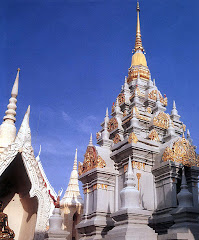
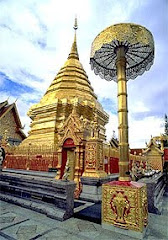
Although animistic beliefs remained potent in Sukhothai, King Ramkhamhaeng and his successors were all devout Buddhist rulers who made merit on a large scale. The major cities of the Sukhothai kingdom were, therefore, full of monasteries, many of which were splendid examples of Thai Buddhist architecture. Sukhothai adopted the Ceylonese school of Theravada Buddhism, beginning with King Ramkhamhaeng's invitation to Ceylonese monks to come over and purify Buddhism in his kingdom. This Ceylonese influence manifested itself not only in matters of doctrine but also in religious architecture. The bell-shaped stupa, so familiar in Thai religious architecture, was derived from Ceylonese models. Sukhothai style Buddha images are distinctive for their elegance and stylized beauty, and Sukhothai's artists introduced the graceful form of the "walking Buddha" into Buddhist sculpture.

Sukhothai's cultural importance in Thai history also derives from the fact that the Thai script evolved into a definite form during King Ramkhamhaeng's time, taking as its models the ancient Mon and Khmer scripts. Indeed, this remarkable king is credited with having invented the Thai script.

Technorati tags : / / /