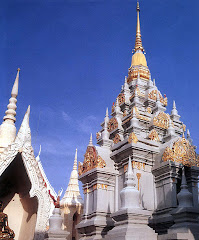
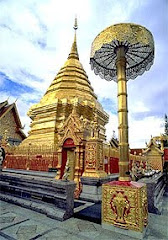
Wat Phra That Doi Noi is in Tambon Doi Lo, Amphoe Chom Thong along Highway No.108 between Km. 43 and 44.
The temple was built by Queen Jamathewi in 658 AD. During excavations, numerous marble Buddha images, Buddha image containers, and a chapel were discovered.
The hilltop temple allows visitors to glance the scenic beauty of the Mae Ping River and surrounding hills and valleys. The temple is approachable on foot by climbing 241 steps.
Related Tags: Chiangmai/Wat Phra That Doi Noi/marble Buddha images/thai temple/temple/wat
Showing posts with label Chiang Mai. Show all posts
Showing posts with label Chiang Mai. Show all posts
Saturday, June 16, 2007
Wat Phra That Doi Noi : Chiang Mai

Bookmark this post:


Tuesday, April 17, 2007
Lanna Temple Buildings

The Ubosot and Viharn are the most ornate and important buildings in a temple compound. On the outside they are decorated with stucco motifs which are covered with lacquer, glass mosaic and gilt.
An Ubosot, or consecrated ceremonial hall, is generally small for its religious functions involve only monks. The ubosot stands in consecrated ground marked by eight boundary stones. Ubosot are often locked and women are generally not allowed to enter.
The viharn is a larger assembly hall where lay people and monks participate in ceremonies. It is usually located to the east of the chedi with the front entrance facing east, the auspicious direction of the sunrise.
Though many viharn in the north are characteristically Lanna in style, details in the architectural styles have been influenced by Ayutthaya and Rattanakosin (Bangkok) styles. Taller walls in the viharn, for example, show a distinct influence of the central (Siamese) Thai. Both the ubosot and the viharn will contain the temple's most important Buddha images. During ceremonies cotton strings may be attached to these to spread the power and blessings of the image amongst devotees. Because of the value of these images and other artifacts, many viharn are kept locked except on Buddhist holy days - wan phra (monks may unlock a viharn if politely requested to do so).

The wall above the front entrance traditionally shows the unsuccessful attack by the demons of Mara, the God of Illusion who attempts to dissuade the Buddha from achieving enlightenment.
Many temples contain a small scripture repository raised up on a pedestal or stilts for protection. Known as ho trai, they are used to keep religious scripts inscribed on palm leaves. These scripts recorded Buddhist texts as well as the chronicles, which are a main source of early Thai history. One of the best examples of a ho trai is at Wat Phra Singh.Other buildings include kuti, the monks' living quarters, general purpose halls known as sala, and a bell tower which announces ritual times to monks.
Temples used to provide the only education and to this day compounds often contain schools. From ancient times the temple grounds have served as a public place for festivals and fairs. The entrances to compounds of important temples in the past would sometimes have heavily decorated entrance gates. Wat Suan Dok is the best example in Chiang Mai.
Funeral rites are held in special halls, or at the home of the deceased. Cremations are carried out at special grounds away from the temples.source: www.chiangmai1.com
Technorati tags : Chiang Mai /thai temple /wat /Thailand Temple /Chedi /Lanna Temple
Bookmark this post:
The Lanna Temple :Chedi
The Chedi

Lanna Temples originally were built round the chedi (stupas), which contain valuable relics of pious kings and monks. Like solid rocks in a sea of change, the old chedis mark the sites of former temples and are almost the only temple structures that go back to the 13th-15th centuries.
Perhaps their continued existence in some unlikely places in the city is no accident. In Brahmanic-Buddhist cosmology, the chedi "stabilizes the earth", fixing a point where heaven and earth meet. They may be likened to the rising sun at dawn, both separating and joining the earth and sky after the darkness of night. Symbolizing the dhamma, they chase away the darkness of ignorance and chaos.
Though many chedi in Chiang Mai have been damaged by thieves who sought the precious relics contained inside, citizens have repaired and protected them. They are worshipped as sacred symbols representing the cosmic body of the Buddha and the law of the dhamma. Their shape differs, however, due to the particular symbolism of the dhamma chosen by the builders.
Chedis in Chiang Mai have two basic forms; the stepped or prasat style, and the bell style. However, from these basic forms many variations in size and shape have appeared, reflecting the wealth of the city over the centuries.
An early example of the prasat style is the Mahapol Chedi at Wat Chamadevi in Lamphun. Later fine examples are those of Wat Pansat near Chang Phuak bus station and Wat Lok Moli west of Chang Phuak gate.
Technorati tags : Chiang Mai /thai temple /wat /Thailand Temple /Chedi /Lanna Temple
Bookmark this post:
The Lanna Temple
Chiang Mai Temples are the cultural and historical heart of the city. The most famous have been places of pilgrimage for northern people for centuries. As traditional centers of merit making, they are the best places to see Buddhist ceremonies. Funded by noble and wealthy benefactors over a long period, they have also become the repositories of some of the finest examples of religious art. If you had but half a day in the city, then it is to one or two of these temples that you should go.
The Lanna Temple


Thai temples have long served as the center of the community. While this traditional role has diminished as young people have had less time for religious observances, the temples still lie at the heart of the ritual and social life of much of society.
Though earlier temples were the most durable constructions of the day, the wooden roofs and older earth filled walls have not survived the destructive forces of nature and man. Therefore most of the temple buildings seen today do not go back much before the 19th century.
Only the stupas (which shall be referred to as chedi) and some walls and sculptured images which were built of laterite or brick covered with stucco have survived for longer periods.Technorati tags : Chiang Mai /thai temple /wat /Thailand Temple
Bookmark this post:
Sunday, April 15, 2007
Buddhism in Thailand : Chiang Mai Period part 2
In the following century (B.E. 2020 or 1477 AD) under the auspices of King Tilokara, the thirteenth of Chieng Mai dynasty and under the leadership of Khammadinna Thera, a general Council of bhikkhus which lasted one year was convened at the Maha Bodhivong Vihara. Practically this was the first Council held in Thailand and reflected the intensive study of Buddhism during the time. A collection of Pali texts, compiled by the Thera (Elders) of that glorious age, are now a pride of the those who wished to further their research of Buddhism in the Pali language. Some such texts were Abhidhammayojana, Mulakaccayanayojana. Vinayayojana, Vessantaradipani and Mangalathadipani. In the following (twenty-second) century the town was taken by the Burmese and from time Chiang-Mai became a unhappy town alternately torn by two superior powers i.e. Burma on her north and the kingdom of Ayutthaya on her south.
source: www.dhammathai.org
Technorati tags : Chiang Mai Period /Chiang Mai /thai temple /Thailand Temple
Bookmark this post:
Buddhism in Thailand : Chiang Mai Period part 1
 While one of the Thai tribes of the Chao Phraya River was founding Sukhothai kingdom, another tribe in the north-western tableland, called Lanna, was also successful in driving out the Mons influence from the River Ping. In the nineteenth Buddhist century King Meng-Rai of the ancient Chiang-San dynasty was known to have defeated King Ye-Ma, the Mon king of the town of Lamphun, and later built his capital at Chiang Mai.During this time Theravada Buddhism of Ceylon had been brought from their flourishing states in the Mons country and in Sukhothai to the north-western tableland, but was not able to take its firm roots there. In the twentieth Buddhist century through the royal order of King-Kue-Na, several “Lankavangsa” bhikkhus both from Moulmein (Mau-Ta-Ma) and from Sukhothai were invited to Chiang-Mai (750 km. north of Bangkok) to preach their doctrine. Of these bhikkhus along with their followers, one named Ananda was from the town of Mua-Ta-Ma in the Mons country and the other called Sumana was from Sukhothai.
Technorati tags : Chiang Mai Period /Chiang Mai /Buddhist /Thailand Temple /thai temple /Sukhothai
Bookmark this post:
Saturday, April 14, 2007
Wat Umong :Chiang Mai
 Wat Umong is an ancient temple in the forest just outside Chiang Mai, off Suthep Road. King Mengrai built this temple for a highly respected forest monk who liked to wander in the countryside, hence the isolated location where the monk could stay quietly and meditate. The temple is unusual in that it has tunnel like chambers in the ground; if you look closely, some of the walls in the cambers have the original paintings of birds and animals still visible.
source: www.guide360.com
Technorati tags : wat umong /Chiang Mai's temples /Chiang Mai /Buddhist temples / Thailand Temple
/wat thai/thai temple
Bookmark this post:
Wat Phrathat Doi Suthep : Chiang Mai

Wat Phrathat Doi Suthep, Established in 1383 and perched on a hilltop overlooking the city, this magnificent temple is famous for its large gold-plated chedi, visible from the city on a good clear day. Although Wat Doi Suthep is the most recently built of the temples dating from the Lanna Thai period, it is the symbol of Chiang Mai. The site was selected by sending an elephant to roam at will up the mountainside. When it reached this spot, it trumpeted, circled three times, and knelt down - which was interpreted as a sign indicating an auspicious site. Entrance to the temple is free for those who wish to climb the 300-plus steps; alternatively, there's a cable car with a 50 baht fare for foreigners. Clearly marked songthaews to Doi Suthep leave from Pratu Chang Phuak, passing Chiang Mai University and the zoo on the way. Prices are fixed at 40 baht up and 30 baht down; the drivers wait until they have sufficient (up to 8) passengers before they depart. The trip takes about 30 minutes one way. Alternatively, the 12kms (often up hill) journey can be made by motorcycle.
photo: www.dhammathai.org
source: www.guide360.com
Tags : Wat Phrathat Doi Suthep\Chiang Mai's temples\Chiang Mai\ Buddhist temples
\Thailand Temple \wat thai\thai temple
Bookmark this post:
Buddhist Temples in Chiang Mai


Buddhist temples in Chiang Mai show off a mixture of architectural styles that reflect the varied heritage of Northern Thailand. Elements from Lanna Thai, Burmese, Sri Lankan and Mon temples have all been used in one form or another. Intricate woodcarvings and protective Naga serpent staircases add a flamboyance that reflects an awesome reverence for the Buddhist religion. Gilded umbrellas, guardian figures from the tales of the Ramayana and stupas trimmed with gold filigree combine to heighten the overall effect.
To date, there have been some 300 temples constructed in Chiang Mai an its outskirts. Visitors should take the time to visit the most revered temples in the city, built during the noble Lanna Thai dynasty. The largest ones draw crowds, but it's well worth wandering off the beaten path and finding a temple not on the tour bus circuit.
The Thai patrons of Chiang Mai's temples are pleased to see that visitors take an interest in the images and traditions of Lord Buddha's teachings. All that they ask is that temple visitors show respect by wearing appropriate attire (long pants for men, modest tops and skirts for women, no bare shoulders and women must wear a brassier) so that monks and worshippers will not be offended within the sacred temple grounds.
source: www.guide360.com
Bookmark this post:
Wat Chiang Man : Chiang Mai
 This temple was built in 1297 at the site of the camp King Mangrai used when he supervised the building of Chiang Mai. It was the first temple to be built in Chiang Mai and contains several very old artifacts. The oldest structure is the Chang Lom chedi, which is in a style that could have originated from Sri Lanka via Sukhothai, or from Pagan. Fifteen elephants represent a sea of unformed matter upon which the cosmos of the chedi floats.
Nearby are a lotus pond, a raised scripture repository and an ubosot. The stela in front of the ubosot was inscribed in 1581, and is one of the oldest known records that establishes the founding date of Chiang Mai.
The temple has two Lanna style viharn. The larger viharn was renovated by Khru Ba Srivichai in the 1920's. The standing Buddha image (front right of the altar) has an inscription on its slightly lopsided square base that dates it to 1465. This makes it the oldest dated Buddha image to be found so far in Chiang Mai. Close study shows new gilt veneer covers pits and cracks that indicate the image's real age.
The smaller viharn to the north (open 09:00-17:00) contains two small but very famous Buddha images. The Phra Sila image is a bas-relief that probably came from Ceylon in about the eighth century. The image is believed to have the power to bring rain and is the focus of a festival at the temple held from April 1-5.
The Phra Sae Tang Khamani crystal image belonged to Queen Chamadevi, who brought it from Lop Buri when she became the first ruler of Haripunchai. The image reputedly survived the burning of Haripunchai when it was razed by King Mangrai, and is honored for its powers to protect against disaster.
source: www.chiangmai1.comTechnorati tags : Wat /Wat Chiang Man /Chiang Mai /Thailand/thai temple
Bookmark this post:
Wednesday, April 11, 2007
Wat Jet Yod : Chiang Mai
Wat Jet Yod or Wat Bhodharam Maha Wiharn

 The Castle-shape Chedi in which are buried the ashes of King Tilokalaga
This wat, situated down a left turn about a kilometre north of Chiang Mai, off the Super Highway Road. It has the usual whitewashed wall surrounding the compound, set amidst banana-leaf-roofed houses in a quiet rural district.
Its popular name, Wat Jet Yod, comes from the seven-spired chedi (Jet Yod = seven spired) in which are buried the ashes of King Tilokalaga. This king chose this site for a wat in 1455 and planted a bhodi tree, said to be taken from bhodi tree in Ceylon. in 1477 he called the Eighth World Buddhist Council Meeting which was held at this very spot. Thus, when he died in 1487, it was natural that he should be cremated here.
Wat Jed Yord is situated on the superhighway off Huay Kaew Road, near the Chiangmai National Museum. Built in 1455 by King Tilokaraja, its name means "Seven Spires" - a description of a jedee's construction. It was copied from the Mahabodi Temple in Bodh Gaya, India, where the Buddha achieved enlightenment. The larger jedee contains the ashes of King Tilokaraja.
source: www.geocities.com/RainForest
Technorati tags : Wat Jet Yod ,Chiang Mai ,wat thai,Thailand,thai temple
Bookmark this post:
Wat Pun Taow, Chiang Mai


Wat Pun Taow was nearly Wat Chedi Luang, the important in this wat is Wiharn, at the beginning was Ho Kum of King Maha Pathad the 5th King of Chiang Mai. During the reign of King Phra Chao Intavityanon, the 7th King of Chiang Mai, was given to made wiharn. At the wiharn having big door and over the door woodcarved at work in Peacock.
Wat Pan Tao is one of the few remaining temples with wooden buildings that are still in good condition.
Technorati tags : thailand ,wat thai ,Chiang Mai,thai temple
Bookmark this post:
Tuesday, April 10, 2007
Wat Chedi Luang : Chiang Mai

King Saen Muang Ma began building the Phra Chedi Luang to enshrine the relics of his father at the end of the 14th century, but King Tilokarat completed it. The chedi used to be 90 meters high before it was partly destroyed in an earthquake in 1545; it was to remain the tallest structure in Chiang Mai for over 500 years. The present restored chedi is about 60 meters high.
One of the best times to see this chedi is during the wian tian ceremony in the evening on one of the main Buddhist festival days.
The large viharn was built in 1928. Round columns with bell shaped bases and lotus finials support the high red ceiling inside. The standing Buddha image inside is known as the Phra Chao Attarot. Made of a combination ofbrass alloy and mortar, the image dates back to King Saen Muang Ma (r.1385-1401). Buddhist posters are placed along the walls between the windows, and cabinets with Buddha images and Bencharong ceramics line the walls.The cross shaped hall to the south of the main viharn contains the city pillar. Statues in small shelters surrounding this building are homes of guardian spirits. Legends say that a hermit (whose image is in a shelter on the west side of the building) went to the God Indra to ask for protection for the city from enemies. On condition that appropriate offerings were made, Indra permitted two kumaphan (mythical human-beast creature) to carry the Inthakhin pillar from the Tavatimsa heaven to the city.
source: www.chiangmai1.com
Technorati tags : Wat thai ,thai temple, Chiang Mai ,Wat chedi luang
Bookmark this post:
Subscribe to:
Posts (Atom)