Showing posts with label Emerald Buddha. Show all posts

Monday, April 30, 2007

The Emerald Buddha in Wat phra kaew

The Emerald Buddha is wearing his summer season costume

The Emerald Buddha is wearing his rainy season costume

The Emerald Buddha is wearing his winter season costume


The
Emerald Buddha is carved from a large piece of green jade. Its size is 48.3 centimeters wide at the knees and 66 centimeters high. The image is in a seated position in the attitude of meditation. Judging from its style, it was made in northern Thailand, not much earlier than the 15th century, and belongs to the late Chiang Saen School. King Rama I had the Emerald Buddha transferred from Thonburi, the from capital of Thailand, to the present site in 1784. He placed it high on a golden throne made of gilt carved wood. The image has three costumes, one for each season—one for summer, one for winter, and one for the rainy season, all made of gold and jewelry. The ceremony of changing the costumes of the Emerald Buddha takes place three times a year, with the King performing the ceremony.

related link : Brief history of emerald buddha


Technorati tags : / / / / / / /

Tuesday, April 17, 2007

Wat Phra Kaew Don Tao :most important temple in the city of Lampang

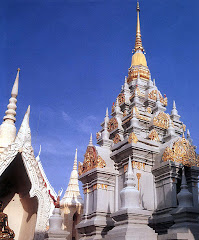
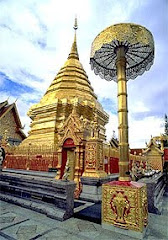
On the right bank of the Wang River is an old building which consists of an impressive chedi on a rectangular base with a round spire, topped with gilded bronze tiles. Nearby is a Burmese-style chapel featuring a multi - tiered roof. The chapel probably dates from the late eighteenth century. Beautiful colors and elaborate harmony make Wat Phra Kaew Don Tao a prime example of Thai architecture.

Perhaps the most important temple in the city of
Lampang is Wat Phra Kaeo Don Tao, the temple of the Emerald Buddha. The temple was home for 32 years in the fifteenth century to Thailand's national symbol, the Emerald Buddha, now housed in its own temple inside Bangkok's Grand Palace.

The temple, and in fact the city of
Lampang itself, is said to have been founded by the son of Lamphun's founder, Queen Chama Devi, in the seventh century. The 50 meter (165 foot) chedi is the only structure that survives of the original temple. In front of the chedi is a Burmese styled open prayer hall built in 1909 by Burmese immigrants at the request of a Thai prince.

In the fringe of trees behind the chedi is a statue of an elephant with a small sort of pavilion on its back. The statue commemorates an event in the legend of the Emerald Buddha image. The image was discovered early in the fifteenth century when lightening cracked open the chedi in Chiang Rai's
Wat Phra Kaeo. After its discovery, the King of Chiang Mai sent some troops with an elephant to bring the image to Chiang Mai. But, as the story goes, the elephant refused to take the road to Chiang Mai and ended up in Lampang instead.

The
Emerald Buddha was allowed to reside at the temple for 32 years before it was finally 'convinced' to be taken to Chiang Mai, where it resided in Wat Chedi Luang.

Elsewhere in the compound is a rather decrepit museum of Lanna culture. Some china and woodcarving is on display.

source: www.thaiabc.com

Technorati tags: / / / / /

Wednesday, April 11, 2007

Brief History of the Emerald Buddha


The Emerald Buddha is in reality carved from a large piece ofgreen jade. According to a reliable cronicle, in 1434 A.D. the Emerald Buddha was found in a chedi in Chiangrai in northern Thailand. Later on it was brought to Lampang province by King Samfangkaen and remained there for 32 years, until 1468 when Chiangmai had a powerful king, King Tiloka had the Emerald Buddha brought to Chiangmai.

In 1551 the king of Chiangmai, who had no son,died. One of his daughters was married to the king of Laos. She had borne one son, name Prince Chaichettha. When the king of Chiangmai

died the ministers of Chiangmai invited the prince, who was fifteen, to become king and he accepted. However, when his father, the king of Laos, passed away, King Chaichettha wanted
to go back to Laos. So he returned to Luang Prabang, the then capital of Laos, taking the Emerald Buddha with him, and promised the ministers of Chiangmai to come back. But he
never returned nor send back the Emerald Buddha, so theimage remained in Luang Prabang for twelve years.

In 1564, King Chaichettha could not resist the Burmese army of King Bayinnuang; thus he moved his capital down to Vientiane and the Emerald Buddha remained there for 214 years.


In 1778, during the Thonburi period, when King Rama I of Bangkok was still a general, he captured Vientiane and brought the emerald Buddha back to Thailand. With the establishment

of Bangkok as the capital, the Emerald Buddha became the palladium of Thailand and has been ever since. The image was moved from Thonburi to the Temple of the Emerald Buddha in
Bangkok on March 22, 1784.

Technorati tags : ,, , ,,