Showing posts with label Wat chedi luang. Show all posts

Tuesday, April 17, 2007

The Lanna Temple :Chedi

The Chedi

Lanna Temples originally were built round the chedi (stupas), which contain valuable relics of pious kings and monks. Like solid rocks in a sea of change, the old chedis mark the sites of former temples and are almost the only temple structures that go back to the 13th-15th centuries.

Perhaps their continued existence in some unlikely places in the city is no accident. In Brahmanic-Buddhist cosmology, the chedi "stabilizes the earth", fixing a point where heaven and earth meet. They may be likened to the rising sun at dawn, both separating and joining the earth and sky after the darkness of night. Symbolizing the dhamma, they chase away the darkness of ignorance and chaos.

Though many chedi in Chiang Mai have been damaged by thieves who sought the precious relics contained inside, citizens have repaired and protected them. They are worshipped as sacred symbols representing the cosmic body of the Buddha and the law of the dhamma. Their shape differs, however, due to the particular symbolism of the dhamma chosen by the builders.

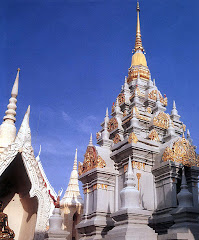
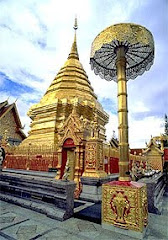
Chedis in Chiang Mai have two basic forms; the stepped or prasat style, and the bell style. However, from these basic forms many variations in size and shape have appeared, reflecting the wealth of the city over the centuries.

An early example of the prasat style is the Mahapol Chedi at Wat Chamadevi in Lamphun. Later fine examples are those of Wat Pansat near Chang Phuak bus station and Wat Lok Moli west of Chang Phuak gate.

The chedi of Wat U-Mong Suan Putha-tham and the later chedi of Wat Phrathat Haripunchai have the bell shaped style. More recent examples are the Shan Burmese style chedis built in the late 19th century. These may be seen at the temples on Thapae Road. Other variations include the octagonal form, which may best be seen at Wat Phrathat Doi Suthep and Wat Duang Di, and the round form best seen at Wat Phuak Hong. Both designs may have evolved here, or may have come with monks or traders from Ayutthaya (the octagonal form) and Lake Erhai in Yunnan (the round form).

Technorati tags : / / / / /

The Lanna Temple

Chiang Mai Temples are the cultural and historical heart of the city. The most famous have been places of pilgrimage for northern people for centuries. As traditional centers of merit making, they are the best places to see Buddhist ceremonies. Funded by noble and wealthy benefactors over a long period, they have also become the repositories of some of the finest examples of religious art. If you had but half a day in the city, then it is to one or two of these temples that you should go.

The Lanna Temple


Thai temples have long served as the center of the community. While this traditional role has diminished as young people have had less time for religious observances, the temples still lie at the heart of the ritual and social life of much of society.

Though earlier temples were the most durable constructions of the day, the wooden roofs and older earth filled walls have not survived the destructive forces of nature and man. Therefore most of the temple buildings seen today do not go back much before the 19th century.

Only the stupas (which shall be referred to as chedi) and some walls and sculptured images which were built of laterite or brick covered with stucco have survived for longer periods.

Technorati tags : / / /

Tuesday, April 10, 2007

Wat Chedi Luang : Chiang Mai


King Saen Muang Ma began building the Phra Chedi Luang to enshrine the relics of his father at the end of the 14th century, but King Tilokarat completed it. The chedi used to be 90 meters high before it was partly destroyed in an earthquake in 1545; it was to remain the tallest structure in Chiang Mai for over 500 years. The present restored chedi is about 60 meters high.

One of the best times to see this chedi is during the wian tian ceremony in the evening on one of the main Buddhist festival days.

The large viharn was built in 1928. Round columns with bell shaped bases and lotus finials support the high red ceiling inside. The standing Buddha image inside is known as the Phra Chao Attarot. Made of a combination ofbrass alloy and mortar, the image dates back to King Saen Muang Ma (r.1385-1401). Buddhist posters are placed along the walls between the windows, and cabinets with Buddha images and Bencharong ceramics line the walls.

The cross shaped hall to the south of the main
viharn contains the city pillar. Statues in small shelters surrounding this building are homes of guardian spirits. Legends say that a hermit (whose image is in a shelter on the west side of the building) went to the God Indra to ask for protection for the city from enemies. On condition that appropriate offerings were made, Indra permitted two kumaphan (mythical human-beast creature) to carry the Inthakhin pillar from the Tavatimsa heaven to the city.

source: www.chiangmai1.com

Technorati tags : , ,