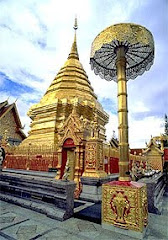
Showing posts with label buddhist temple. Show all posts

Tuesday, February 9, 2010

Wat Phra Boromthat and Ancient Tak City : Tak


The area of Wat Phra Boromthat in Amphoe Ban Tak is the former site of Ancient Tak City. Lying along the bank of Maenam Ping, approximately 25 kilometers north of the City, the site contains several ruins including the legendary hill-top pagoda in Phum Khao Binth style (of Sukhothai era).

The pagoda was built by King Ramkhamhaeng the Great to mark his victory in the hand to hand combat on the elephants back against King Khun Sam Chon, the ruler of Muang Chot (currently Amphoe Mae Sot). The pagoda shares Myanmar's famous Chawedagong's features and houses holy Buddha relics. Locally known as the royal pagoda or Chedi Yutta Hatthi, it is located next to Wat Phra Boromthat.

The temple (Wat Phra Boromthat) itself is extraordinary with wooden door panels and roof decorations that are magnificently crafted. In addition, the story of the Lord Buddha is depicted on the temples wooden window panels which are covered in real gold.

Photo credits to thai-tour.com

Wat Si Talaram : Tak


Located in Trok Ban Chin, Wat Sri Talaram is not just an ordinary temple located in a peaceful area. The most unique feature of Wat Sri Talaram is its European-style architecture, reflected in its ordination hall. In addition, enshrined within the sermon hall made of carved wood is an ancient Ayuthaya-style Buddha image.
Photo credits to thai-tour.com

Sunday, January 24, 2010

Wat Chula Mani : Samut Songkhram


Wat Chula Mani is located on Highway 325 (Samut Songkhram – Bang Phae) between Km 34-35 in Tambon Bang Chang. This ancient temple sits on the bank where the Amphawa Canal connects with the Phi Lok Canal. The temple was built in the Ayutthaya period during the late reign of King Prasatthong. It was presumed that Thao Kaeophaluek (Noi), Mistress of the Bang Chang Market and a forebear of the royal lineage of Bang Chang, built the temple. The back of the temple was initially the residence of Khun Nak (Queen Ammarinthramat of King Rama I) and Khun Bunrot (Queen Si Suriyenthramat of King Rama II).

Photo credits to thai-tour.com

Wat Samuha Pradittharam : Saraburi


Wat Samuha Pradittharam is located in Suan Dok Mai Sub-district, 2 kilometres from the District Office. Its Ubosot was completely constructed in 1897.


mural painting in Wat Samuha Pradittharam

Inside are very beautiful mural paintings depicting the Khawi folk tale, the main Buddha image taken from Sukhothai’s Ancient City and cast of bronze covering with gold leaves in the posture of subduing Mara, as well as, the images of the Lord’s 2 major disciples: Moggallana and Sariputta residing on both sides. In September every year, a traditional long boat race is organised at this temple.

photo credits to www.saraburitourism.com

Tuesday, November 3, 2009

Wat Songtham Worawihan : Samut Prakarn


Wat Songtham Worawihan is an old temple of Mon-Buddhism sect. It was constructed at the same time when Muang Nakhon Khuaenkhan was being built, during the reign of King Rama III. At present, it is a second class royal monastery. The huge Phra Raman Chedi was built in Mon style. Buildings in this temple are built of brick and cement. A decoration on the roof of the temple is made of teak. The replication of Lord Buddha's Footprint was enshrined inside the temple.

Tags : / /

Wednesday, October 14, 2009

Wat Phra Si Rattana Mahathat : Ratchaburi


This ancient temple, locally called Wat Na Phra That, is situated on the west bank of the Mae Klong River in the town. Its elegant prang or pagoda remains in good condition and was probably copied from Cambodia's Angkor Wat. The prang made of bricks and stones stands on a rectangular base with pathways around the cloisters. The outer stucco designs were made in the reign of King Borommakot of Ayutthaya. Buddha images of Dvaravati, Lop Buri and Ayutthaya periods are placed around the pagoda.

2 kilometres west of Wat Na Phra That on the route to Khao Ngu is Wat Aranyik with a prang identical to that of Wat Na Phra That but smaller in size.

Photo credits to
http://ecurriculum.mv.ac.th

Tags: /////

Wat Khian Bang Kaeo : Phatthalung


This temple is on Highway No. 4081, 7 kilometres past Khao Chaison district office, in the area of Ban Bang Kaeo at Km. 14. A left-hand road leads to the temple. Wat Khian is situated on the bank of Songkhla Lake. This old monastery has the sacred Phra That Bang Kaeo, built in the same style as Phra Maha That Chedi in Nakhon Si Thammarat but smaller. This is one of the oldest historical sites of Phatthalung, dating back to the early Ayutthaya period. It is believed that the temple area was once the site of Phatthalung town because many laterite ruins and Buddha images have been found her

Tags: /////

Friday, October 9, 2009

Wat Li : Phayao


Wat Li is located at Ban Lai Ing, near the 3rd Municipality School, Wiang Sub-district. It is an ancient and significant temple of Phayao constructed in 1495 to be presented to Phrachao Yot Chiang Rai, the king of Chiang Mai Town.

Li is its original name. It is an ancient northern Thai dialect, meaning Kat or Talat or market. Therefore, it means a temple in the area of the market community. Within the compound of the temple, there are important ancient remains; namely, Phrathat Wat Li, and many artefacts of the Phayao Kingdom, especially the sandstone Buddha images. Moreover, there is a museum collecting various artefacts.

Photo credits to www.thai-tour.com

Related Post :Temple in Phayao
- Wat Tha Fa Tai
- Wat Analayo-Doi Busarakham

Tags: /////

Wednesday, September 30, 2009

Wat Khao Khunpanom : Nakhon Si Thamarat


This temple is at Moo 3, Tambol Baan Koh, take Highway 4016 from the city to 21st Milestone pass Promloke Market, turn right into the street for another 2.5 km.

Wat Khao Khunpanom is an important temple in history and archaeology. It has caves with cement wall and markers like the city wall. The front wall is decorated with chinaware. Inside the caves are about 30 statues of Buddha made from copper and a copper Buddha’s footprint.

Some of the caves here are connected. It was assumed that this was the residency of King Taksin the Great but some said it was the recreation place of Princess Kaesinee the daughter of Chao Nara Suriyawong, who ruled Nakhonsithammarat from 1769 to 1776.

From the conversation of the monk at this temple, there are many who believe that this was the place King Taksin came to make merit with his followers after being abdicated from the throne. He later died while being a monk at this temple. On the walkway up the hill, there’s a Science Centre for Study of Khao Khunpanom to give knowledge in science, technology, environment and eco-tourism to the public.

The community of Khao Khumpanom is a cultural community. There are many activities such as boy-scout camping & meeting, tourism group to visit fruit orchards with bicycles, etc.

Photo credits to www.thai-tour.com
[source: www.nakhontourism.org]

Tags: /////

Thai Style Monk’s House at Wat Wang West : Nakhon Si Thamarat


It’s situated on Ratchadamnern Road on the area that is believed to be opposite the East Palace that belonged to Chaojom Prang. It used to be a park and later Chaophaya Nakhon (Noi) gave the East Palace and the park opposite to the temple so it became Wat Wang West (West Palace Temple). In 1888, Prakroo Kachad (Yong) and his disciples had built a set of monk’s house with 3 buildings consisted of gabled-roof, each roof connected to each other. The houses used carved- wooden partitions. The doors, windows and ventilators were decorated with unique Nakhon-style. In 1992 the Siam Architectural Society had picked
[source: www.nakhontourism.org]

Tags : // /

Wat Si Mongkhon Tai : Mukdahan


Wat Si Mongkhon Tai is near the immigration checkpoint. The temple houses an important Buddha image of the province, Phra Chao Ong Luang, an image built before the citys founding. This brick image is 2.2 metres wide and 2 metres high. According to legend, the first lord of Mukdahan discovered it while he was overseeing the citys construction. In addition, another image made of steel was found under a Bodi tree with only its top part protruding from the ground.

Photo credits to
www.thai-tour.com

Tags: /////

Saturday, September 19, 2009

Wat Phra Si Maha That : Lopburi


The oldest temple with tallest Prang in Lop Buri, Wat Phra Si Maha That is located behind the railway station near the San Phra Kan. The Lop-Buri style prang in front of the temple was built around 1157 when the town came under Khmer rule. The U-Thong style Buddha images on the prang and the large viharn were later added by King Narai the Great. The laterite prang still has some original lintels and stucco work intact. A number of other chedis and prangs - most of which were restored were greatly influenced by both the Sukhothai and Ayutthaya styles.

The admission fee is 50 baht each. A package ticket is also visiting at 150 baht each, covering admission to Phra Prang Sam Yot, Vichayen House and Kraison Siharat Hall


[ Photo credits to http://lms.thaicyberu.go.th ]

Tags: /////

Thursday, September 17, 2009

Wat Phra Bat Huai Tom : Lamphun


Wat Phra Bat Huai Tom
is the largest temple in the district, boasting a large Lanna-style Chedi and an extensive place of worship built in laterite by Karens living in the vicinity who were admirers of the highly revered Phra Kru Ba Chaiwongsa. The temple is about 5 kilometres off Highway No. 106 at Km. 47. About 2 kilometres from Li is a group of five old pagoda known as the Chedi Ha Duang The site is believed to have been an ancient town. Covering an area of over 1,000 square kilometres is the Mae Ping National Park. Its main feature is the Ping River, which flows through the forests in the park. On both sides are fertile forest-lands with sheer cliffs providing beautiful natural scenery. Certain parts of the waterway spread out to form reservoir-like bodies of water with numerous small islands and rapids.

[Photo source: www.rakpratat.com]

Tags: /////

Wat Phra That Chom Ping and Wat Si Rong Mueang : Lampang


Wat Phra That Chom Ping :
Using the same route as Wat Phra That Lampang Luang but taking a left turn at the district office and continue on for 14 kilometres is Wat Phra That Chom Ping. Another age-old temple of Lampang, its unique feature is the reflections in natural colors of Chedi which appear on the floor within the dark interior of the Ubosot.


Wat Si Rong Mueang
:
To the west of town is Wat Si Rong Mueang , a Burmese temple built in 1905 during the time when Lampang was the commercial and forestry centre. Major architectural works include the Vihan made of wood with several overlapping gables in the Burmese style. It is a temple with elaborate carving decorations and plaster designs adorned with colored glass fashioned with delicate craftsmanship.

Photo source: www.lampangcity.go.th, www.thai-tour.com

Tags : // ///

Wat Tham Suea ( Tiger Cave Temple ) : Krabi


Wat Tham Suea
,
also known as "Tiger cave Temple," is located in the Khiriwong Valley amidst lush forests and mountains with large trees over a hundred years old approximately 9 kilometers northeast of Krabi Town. Aside from being the site of a meditation center, the compound is also a place of archaeological and historical interest as excavations have uncovered stone tools, pottery remains and Buddha footprint crafting molds. In addition, a cave in the compound has what appears to be tiger paw prints in the stone.

Photo source : www.watthumsuakrabi.com

Tags : ////

Wat Phra That Doi Tung : Chiang Rai


Wat Phra That Doi Tung
is located on top of Doi Tung Mountain, the highest mountain in Chiang Rai Province with an elevation of approximately 2,000 meters, about 50 kilometers south of Mae Sai town which is near the Myanmar border. The temple can be reached via a 40-kilometer mountain road which meanders along the mountainside. The journey is worthwhile as the panoramic views into Laos and Myanmar at the peak are spectacular.

Wat Phra That Doi Tung was constructed in the 10th century and was renovated by Chiang Rai's most famous ruler King Mengrai during the 13th century and by the famous Chiang Mai monk, Khru Ba Siwichai, at the turn of the 20th century.

The temple complex is comprised of twin Lanna style chedis, one of which is said to contain the left collarbone of the Lord Buddha. Throughout the year, the holy relic draws devout Buddhists from all over Thailand, Laos and Myanmar.

Tags : ////

Friday, September 11, 2009

Wat Chaiyo Worawihan or Wat Ket Chaiyo : Ang Thong


Wat Ket Chaiyo
is situated on the west bank of the Chao Phraya River, approximately 18 kilometers away from Amphoe Mueang Ang Thong, on Ang Thong Sing Buri route. This is the second-class royal monastery. Formerly it was a small ordinary temple constructed in the Ayutthaya period with the unknown building date. Later in the reign of King Rama IV, this temple was noted when Somdet Phra Phutthachan (To Phromrangsi) a revered monk of Wat Rakhangkhositaram in Thonburi constructed a large seated Buddha image in the posture of meditation made of white plaster.
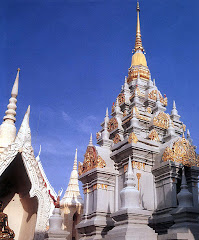
In the reign of King Rama V, His Majesty the King went to worship the image and had Wat Chaiyo renovated in 1887 but the vibration from ramming piles of the wihan caused the large Buddha image to collapse. The king then commanded to build a new large Buddha image following the pattern of the large Buddha image at Wat Kalayanamit. The new one has the lap width of 16.10 meters and the height (from radiance to feet) of 22.65 meters and was graciously named Phra Mahaphutthaphim. There was the biggest celebration for the image ever held in Ang Thong at that time. The molded statue of Somdet Phra Phutthachan (To Phromrangsi) constructed in 1894, having the lap width of 5 meters and the height of 7 meters, has been enshrined in the wihan facing the Chao Phraya River.


The large Buddha image housed in this wihan is larger, more elegant, and more remarkable wihan than any other, therefore, Buddhists from various parts of the country have continuously paid homage to this image. In front of the wihan, the ubosot facing the was constructed using the magnificent Thai architectural design. Inside the ubosot, there are mural paintings depicting scenes of the Lord Buddhas chronicles painted by the artisan in the reign of King Rama V, and the molded statue of Somdet Phra Phutthachan (To Phromrangsi) from Thonburi. At present, Chao Phraya RiverWat Chaiyo Worawihan has been renovated to exhibit its distinctive beauty.

Photo credits to kedchaiyo.com, dhammathai.org

Tags: //////

Wat Phra Thaen Sila At : Uttaradit


[ Photo : ecurriculum.mv.ac.th ]

A little further from Wat Phra Yun, some 14 kilometres from town is Wat Phra Thaen Sila At. The major feature is the base of a sermon platform built with laterite. The square slab with pattern is believed to have been made during the Sukhothai Period. Annual celebrations are held at the three temples in February.

Tags :
////

Tuesday, September 1, 2009

Wat Protketchettharam : Samut Prakarn


[ Photo credits to www.culture.go.th ]

Located at Tambon Song Kha Nong, this is the only Thai-Buddhism temple in Phra Pradaeng. Other temples are of the Mon-Buddhism sect. Phraya Phetphichai built it during the reign of King Rama II. A distinct and unique architectural characteristic of the temple is that its roof is covered with ancient Mon ceramic shingles, without any decorations on the temple roof. The front of the main building, Ubosot, above the entrance, is done with stucco adorned with vine lines and decorated with ancient porcelain and ceramic pieces. Inside, there is a cast-metal Buddha image in the attitude of Subduing Mara.

The second main building, Wiharn, has the same architecture as the first building. Inside the second main building, there is a reclining Buddha of which the face is very beautiful. Above the windows, there are the pictures of Dhamma Riddles of western arts style, which is extremely rare. Another building, Mondop, has a roof that is covered with ceramic shingles and decorated with small Chinese pavilions all around the edge of the roof. It enshrines Buddha images in many the attitudes and has chedis at all 4 corners. Inside the Mondop, there are Buddha images and the replication of Lord Buddha's Footprint, decorated with pearl inset.

Tags : / / / /

Friday, January 2, 2009

Wat Luang : Phrae


[ photo credit: thai-tour.com]


Wat Luang
on Kham Lue Road in town is an ancient and principal temple built at the same time Phrae was established. Several restoration works have taken place. Some of its major features include the Vihan and Chiang Saen-style Chedi enshrining a Holy Relic brought over from Myanmar. Others are the museum housing various antiquities including several 500-year-old Buddha statues and an ancient Lanna-style wooden structure.


Tags: /////