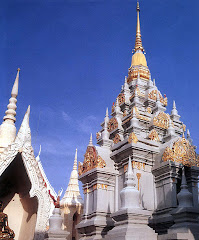
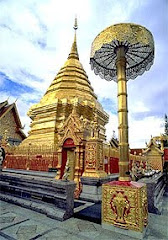
Wat Tha Sung (another name is Wat Chantharam) is at Mu 2, Tambon Nam Sum. It is an old temple from the Ayutthaya period. It was formerly called “Wat Chan” which is the name of an abbot. Wat Chantharam later was abandoned until 1789 when the monk Luang Pho Yai came here. Villagers asked him to become the abbot of the temple and he renovated it.
The first location of the temple was on the bank of Sakae Krang River. The artifact of the place is a pulpit built by Luang Pho Yai that is opposite the temple. More buildings were later added by the monk Phra Ratchaphrom Yan Nen (Luang Pho Ruesi Ling Dam). The new convocation hall is beautiful with an ornately decorated interior.
The inner windows and doors have pictures of angels. His Majesty the King presided over a ceremony to officially open the building. Surronding the building is a traditional columned wall. Images of Luang Pho Pan and Luang Pho Yai 3 times the actual size is at the corner of the front wall. Furthermore, the new site has a wide area as well as many pavilions with accommodation for meditation. The main hall is open during 09.00-11.45 hrs. and 14.00-16.00 hrs. daily.
Thursday, May 26, 2011
Wat Tha Sung : Uttraradit


Sunday, May 8, 2011
Wat Ming Mueang : Nan

Wat Ming Mueang is on Suriyaphong Road. It was constructed in 1857. Its distinguishing point is the stucco reliefs on the outer wall of the ubosot, presenting the skill of the Chiang Saen craftsmen. The patterns are very exquisite. Within the ubosot are mural paintings depicting the lifestyles of the Nan people by present-day local craftsmen. Moreover, within the compound of the temple stands the city pillar in a cruciform-plan pavilion at its front. The city pillar is 3 metres high. Its base is decorated with engraved and gilded wooden design. The top of the pillar was engraved into 4 faces of the Brahma God, representing Phrom Wihan (Brahmavihara) 4 – the four sublime states of mind; namely, Metta - kindness, Karuna - compassion, Mudita – sympathy, and Upekkha - equanimity.
Wat Woranat Banphot : Nakhon Sawan

Wat Woranat Banphot (Khao Kop) is an old temple of the province on the peak of Khao Kop 185.5 meters above sea level. There are 2 ways up; a stairway of 439 steps and an asphalt road 3 meters wide. The peak has a replica of Lord Buddhas Footprint and a pagoda encasing the relic of Lord Buddha built when Sukhothai was the countrys capital. The temple was praised by the Department of Religious Affairs as the best development temple of 1966. A nearby hill is the site of some television relay stations.
Tuesday, February 9, 2010
Wat Phra Boromthat and Ancient Tak City : Tak

The area of Wat Phra Boromthat in Amphoe Ban Tak is the former site of Ancient Tak City. Lying along the bank of Maenam Ping, approximately 25 kilometers north of the City, the site contains several ruins including the legendary hill-top pagoda in Phum Khao Binth style (of Sukhothai era).
The pagoda was built by King Ramkhamhaeng the Great to mark his victory in the hand to hand combat on the elephants back against King Khun Sam Chon, the ruler of Muang Chot (currently Amphoe Mae Sot). The pagoda shares Myanmar's famous Chawedagong's features and houses holy Buddha relics. Locally known as the royal pagoda or Chedi Yutta Hatthi, it is located next to Wat Phra Boromthat.
The temple (Wat Phra Boromthat) itself is extraordinary with wooden door panels and roof decorations that are magnificently crafted. In addition, the story of the Lord Buddha is depicted on the temples wooden window panels which are covered in real gold.
Photo credits to thai-tour.com
Wat Si Talaram : Tak

Located in Trok Ban Chin, Wat Sri Talaram is not just an ordinary temple located in a peaceful area. The most unique feature of Wat Sri Talaram is its European-style architecture, reflected in its ordination hall. In addition, enshrined within the sermon hall made of carved wood is an ancient Ayuthaya-style Buddha image.
Photo credits to thai-tour.com
Wat Khao Di Salak : Suphanburi


Archaeologists presumed that the footprint is an art object of the Dvaravati style, dating back to 9th -11th century. Furthermore, Buddha images and artefacts were discovered from a rock cavity. From the peak, you can enjoy a panoramic view of the town.
Photo credits to www.suphanburi.go.th
Wat Pa Lelai : Suphanburi


This is a very old temple located on the west bank of the river on Malaimaen Road in the town. It is believed to have been built some 800 years ago when Suphan Buri was a prosperous community. A huge sitting Buddha image named "Luang Pho To", 23 metres in height, is enshrined in the main chapel. The image was originally situated in the open area and was later covered by the chapel. Worship fairs celebrating the image are held twice a year in April and November.
In addition, an old Thai style house called Khum Khun Chang has been built in the temple compound. The design of the construction has followed the description in Khun Chang-Khun Phan, a classic Thai poem which is a work of Sunthon Phu, the greatest poet of Thailand during the early Bangkok period.
Photo credits to www.suphanburi.go.th
Sunday, January 24, 2010
Wat Chula Mani : Samut Songkhram

Wat Chula Mani is located on Highway 325 (Samut Songkhram – Bang Phae) between Km 34-35 in Tambon Bang Chang. This ancient temple sits on the bank where the Amphawa Canal connects with the Phi Lok Canal. The temple was built in the Ayutthaya period during the late reign of King Prasatthong. It was presumed that Thao Kaeophaluek (Noi), Mistress of the Bang Chang Market and a forebear of the royal lineage of Bang Chang, built the temple. The back of the temple was initially the residence of Khun Nak (Queen Ammarinthramat of King Rama I) and Khun Bunrot (Queen Si Suriyenthramat of King Rama II).
Photo credits to thai-tour.com
Wat Samuha Pradittharam : Saraburi


mural painting in Wat Samuha Pradittharam
Inside are very beautiful mural paintings depicting the Khawi folk tale, the main Buddha image taken from Sukhothai’s Ancient City and cast of bronze covering with gold leaves in the posture of subduing Mara, as well as, the images of the Lord’s 2 major disciples: Moggallana and Sariputta residing on both sides. In September every year, a traditional long boat race is organised at this temple.
photo credits to www.saraburitourism.com
Tuesday, November 3, 2009
Wat Songtham Worawihan : Samut Prakarn

Wat Songtham Worawihan is an old temple of Mon-Buddhism sect. It was constructed at the same time when Muang Nakhon Khuaenkhan was being built, during the reign of King Rama III. At present, it is a second class royal monastery. The huge Phra Raman Chedi was built in Mon style. Buildings in this temple are built of brick and cement. A decoration on the roof of the temple is made of teak. The replication of Lord Buddha's Footprint was enshrined inside the temple.
Tags : buddhist temple /Thailand Temple /Thailand
Wednesday, October 14, 2009
Wat Phra Si Rattana Mahathat : Ratchaburi

This ancient temple, locally called Wat Na Phra That, is situated on the west bank of the Mae Klong River in the town. Its elegant prang or pagoda remains in good condition and was probably copied from Cambodia's Angkor Wat. The prang made of bricks and stones stands on a rectangular base with pathways around the cloisters. The outer stucco designs were made in the reign of King Borommakot of Ayutthaya. Buddha images of Dvaravati, Lop Buri and Ayutthaya periods are placed around the pagoda.
2 kilometres west of Wat Na Phra That on the route to Khao Ngu is Wat Aranyik with a prang identical to that of Wat Na Phra That but smaller in size.
Photo credits to http://ecurriculum.mv.ac.th
Tags: Wat Phra Si Rattana Mahathat/Ratchaburi/buddhist temple/Thailand/thai temple/wat thai
Wat Khian Bang Kaeo : Phatthalung

This temple is on Highway No. 4081, 7 kilometres past Khao Chaison district office, in the area of Ban Bang Kaeo at Km. 14. A left-hand road leads to the temple. Wat Khian is situated on the bank of Songkhla Lake. This old monastery has the sacred Phra That Bang Kaeo, built in the same style as Phra Maha That Chedi in Nakhon Si Thammarat but smaller. This is one of the oldest historical sites of Phatthalung, dating back to the early Ayutthaya period. It is believed that the temple area was once the site of Phatthalung town because many laterite ruins and Buddha images have been found her
Tags: Wat Khian Bang Kaeo/Phatthalung/buddhist temple/Thailand/thai temple/wat thai
Friday, October 9, 2009
Wat Li : Phayao

Wat Li is located at Ban Lai Ing, near the 3rd Municipality School, Wiang Sub-district. It is an ancient and significant temple of Phayao constructed in 1495 to be presented to Phrachao Yot Chiang Rai, the king of Chiang Mai Town.
Li is its original name. It is an ancient northern Thai dialect, meaning Kat or Talat or market. Therefore, it means a temple in the area of the market community. Within the compound of the temple, there are important ancient remains; namely, Phrathat Wat Li, and many artefacts of the Phayao Kingdom, especially the sandstone Buddha images. Moreover, there is a museum collecting various artefacts.
Photo credits to www.thai-tour.comRelated Post :Temple in Phayao
- Wat Tha Fa Tai
- Wat Analayo-Doi Busarakham
Tags: Wat Li/Phayao/buddhist temple/Thailand/thai temple/wat thai
Wednesday, September 30, 2009
Wat Khao Khunpanom : Nakhon Si Thamarat

This temple is at Moo 3, Tambol Baan Koh, take Highway 4016 from the city to 21st Milestone pass Promloke Market, turn right into the street for another 2.5 km.
Wat Khao Khunpanom is an important temple in history and archaeology. It has caves with cement wall and markers like the city wall. The front wall is decorated with chinaware. Inside the caves are about 30 statues of Buddha made from copper and a copper Buddha’s footprint.
Some of the caves here are connected. It was assumed that this was the residency of King Taksin the Great but some said it was the recreation place of Princess Kaesinee the daughter of Chao Nara Suriyawong, who ruled Nakhonsithammarat from 1769 to 1776.
From the conversation of the monk at this temple, there are many who believe that this was the place King Taksin came to make merit with his followers after being abdicated from the throne. He later died while being a monk at this temple. On the walkway up the hill, there’s a Science Centre for Study of Khao Khunpanom to give knowledge in science, technology, environment and eco-tourism to the public.
The community of Khao Khumpanom is a cultural community. There are many activities such as boy-scout camping & meeting, tourism group to visit fruit orchards with bicycles, etc.
Photo credits to www.thai-tour.com[source: www.nakhontourism.org]
Tags: Wat Khao Khunpanom/Nakhon Si Thamarat/buddhist temple/Thailand/thai temple/wat thai
Thai Style Monk’s House at Wat Wang West : Nakhon Si Thamarat

It’s situated on Ratchadamnern Road on the area that is believed to be opposite the East Palace that belonged to Chaojom Prang. It used to be a park and later Chaophaya Nakhon (Noi) gave the East Palace and the park opposite to the temple so it became Wat Wang West (West Palace Temple). In 1888, Prakroo Kachad (Yong) and his disciples had built a set of monk’s house with 3 buildings consisted of gabled-roof, each roof connected to each other. The houses used carved- wooden partitions. The doors, windows and ventilators were decorated with unique Nakhon-style. In 1992 the Siam Architectural Society had picked
[source: www.nakhontourism.org]
Wat Si Mongkhon Tai : Mukdahan

Wat Si Mongkhon Tai is near the immigration checkpoint. The temple houses an important Buddha image of the province, Phra Chao Ong Luang, an image built before the citys founding. This brick image is 2.2 metres wide and 2 metres high. According to legend, the first lord of Mukdahan discovered it while he was overseeing the citys construction. In addition, another image made of steel was found under a Bodi tree with only its top part protruding from the ground.
Photo credits to www.thai-tour.com
Friday, September 25, 2009
Phra Narai Ratchaniwet (King Narais Palace) : Lopburi (2)

[Photo credits to www.tat.or.th]
Structures built during the reign of King Narai the Great include:
Chantara Phaisan Pavilion The first Palace of King Narai the Great in Lop Buri, the Pavilion was subsequently turned into an audience hall after he moved his residence to the Suttha Sawan Pavilion. The fact that the building is of pure Thai architectural style indicates that no French architects were involved in the design and construction process. King Rama IV (King Mongkut of the Ratanakosin era) restored the building in 1863. The Pavilion was once used by the privy-council as a meeting hall. Now, it serves as a hall displaying archaeological and art objects, especially the Lop Buri-style stone Buddha images, historic paintings from the era of King Narai the Great and Buddhist art objects from the Ayutthaya and Ratanakosin period.
Phra Khlang Supharat This compound was built as a place to store royal treasures and royal goods sold to foreign merchants during the late 1600s. It is commonly known as the Twelve Treasure Houses.
Elephant and Horse Stables This compound is located close to the wall separating the outer and middle sections of the Palace.
The Water Reservoir Constructed during the reign of King Narai the Great, the reservoir stored water which came from a freshwater lake Tale Chupsorn, through the well designed terra cotta pipes. Tale Chupsorn was the main lake supplying drinking water to Lop Buri residents.
The Dusit Sawan Thanya Maha Prasat Hall Constructed under the royal command of King Narai the Great, the Hall was formerly used by King Narai as an audience hall receiving high-ranking foreign ambassadors. This was the place where the King received Chevalier de Chaumont, the representative of King Louis XIV of France. The Hall was built in a perfect blending of French and Thai architectural styles.
The Suttha Sawan Pavilion The Pavilion was once located amidst a beautifully decorated garden with ponds and fountains. This was the place where King Narai the Great resided and died on 11 July 1688. Apart from the Pavilion, which had been restored by King Mongkut, only the remains of man-made hills and fountains can be seen.
Kraison Siharat Hall Commonly known as Phra Thinang Yen, the Hall is located on an island in a dried up lake, Thale Chupson, which once supplied fresh drinking water to the people of Lop Buri. Kraison Siharat Hall was used as the residence of King Narai, Jesuits and envoys of King Louis XIV of France when they came to witness a lunar eclipse on 11 December, 1685
Phra Chao Hao Building Built by King Narai the Great, the building is located to the south of the outer section of the palace. Serving as the Kings private audience hall, the building featured Thai-style architecture of which it is currently possible to see only the remains of wall sections with visible decorative motifs at the doors and windows.
Banquet Hall Surrounded on three sides by ponds, the Hall was built to entertain important foreign visitors. One of the remains includes a brick platform facing the Hall, which was used as a stage or theater possibly for shadow plays or dances indicating that the place was once used as an entertainment compound.
Phiman Mongkut Pavilion This pavilion was a three-story brick building where King Rama IV (King Mongkut) resided when he visited Lop Buri during the renovation of the Palace. Connected to the pavilion are three other buildings namely Suttha Winitchai Pavilion, Chai Sattrakon Pavilion and Akson Sattrakhom. All of these buildings are now being used as the offices of the Lop Buri National Museum. A group of eight two-story buildings built behind King Mongkut's residence (Phiman Mongkut Pavilion), which were used as residences for inner court officials. This is located at the entrance of the middle court.
Phra Prathiap Building
Royal Guards Residence
Phra Narai Ratchaniwet (King Narais Palace) : Lopburi (1)
Phra Narai Ratchaniwet (King Narais Palace) : Lopburi (1)

[Photo credits to www.tat.or.th]
The palace was built in 1665 and 1677, when King Narai the Great decided to make Lop Buri the second capital of the Ayutthaya Kingdom. Although the buildings were designed by with the contributions of French architects, the Khmer influence was still strong. The Palace was a perfect blend of the both world, an awesome mixture of Khmer-European styles.
After the death of King Narai the Great in 1688, the palace was deserted. It was not until the reign of King Rama IV during the Ratanakosin era, that the Palace was restored and renamed Narai Ratchaniwet.
The Palace is located in the town center, between Ratchadamnoen Road and Pratu Chai Road. The whole complex has been turned into the Lop Buri National Museum (commonly known as King Narai National Museum).
The Palace can be accessed through the Pratu Phayakkha, which is currently a town park, located off Sorasak Road. The Palace opens Wednesdays through Sundays from 7.30 a.m. to 5.30 p.m.
Within the Palace lies a number of compounds containing pavilions, some built during the reign of King Narai and others constructed during the reign of King Rama IV.
Tags: Phra Narai Ratchaniwet/Lopburi/Thailand/ancient/Palace
Saturday, September 19, 2009
Wat Phra Si Maha That : Lopburi

The oldest temple with tallest Prang in Lop Buri, Wat Phra Si Maha That is located behind the railway station near the San Phra Kan. The Lop-Buri style prang in front of the temple was built around 1157 when the town came under Khmer rule. The U-Thong style Buddha images on the prang and the large viharn were later added by King Narai the Great. The laterite prang still has some original lintels and stucco work intact. A number of other chedis and prangs - most of which were restored were greatly influenced by both the Sukhothai and Ayutthaya styles.
The admission fee is 50 baht each. A package ticket is also visiting at 150 baht each, covering admission to Phra Prang Sam Yot, Vichayen House and Kraison Siharat Hall
[ Photo credits to http://lms.thaicyberu.go.th ]
Tags: Wat Phra Si Maha That/Lopburi/buddhist temple/ancient/thai temple/wat thai
Thursday, September 17, 2009
Wat Phra Bat Huai Tom : Lamphun

Wat Phra Bat Huai Tom is the largest temple in the district, boasting a large Lanna-style Chedi and an extensive place of worship built in laterite by Karens living in the vicinity who were admirers of the highly revered Phra Kru Ba Chaiwongsa. The temple is about 5 kilometres off Highway No. 106 at Km. 47. About 2 kilometres from Li is a group of five old pagoda known as the Chedi Ha Duang The site is believed to have been an ancient town. Covering an area of over 1,000 square kilometres is the Mae Ping National Park. Its main feature is the Ping River, which flows through the forests in the park. On both sides are fertile forest-lands with sheer cliffs providing beautiful natural scenery. Certain parts of the waterway spread out to form reservoir-like bodies of water with numerous small islands and rapids.
[Photo source: www.rakpratat.com]
Tags: Lamphun/Wat Phra Bat Huai Tom/buddhist temple/Thailand Temple/Wat/thai temple